
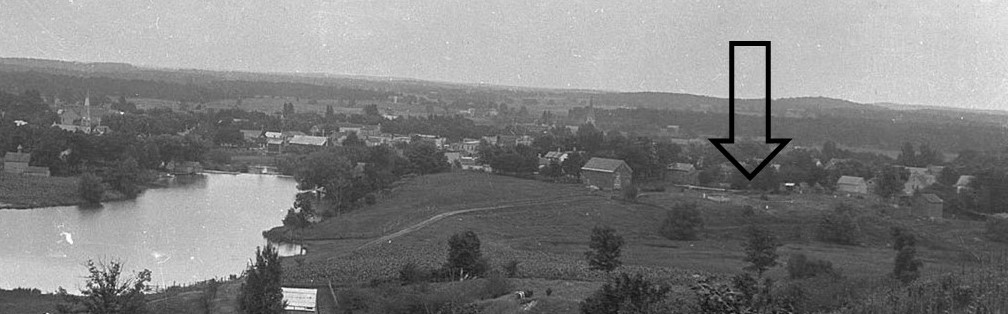
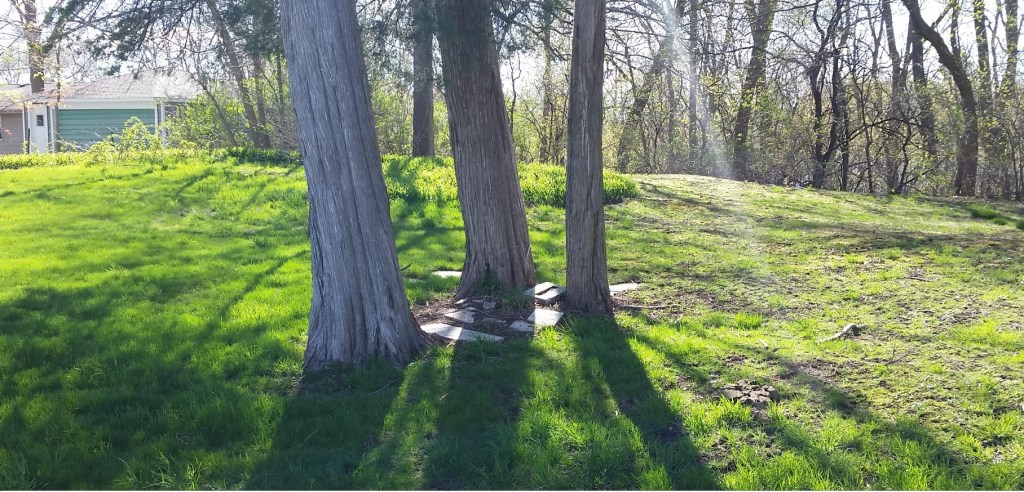
Waterford Village Cemetery – aka. Old Settlers Cemetery – The End of an era.
The cemetery is located on the west side of Riverside Dr. (formerly North Jefferson Street), two blocks north of Main Street, at the corner of North Street. Originally, this site was known as Waterford Village Cemetery, and over time, writers of the narrative of the time, referred to it as the Old Settlers Cemetery, a term of respect for those that established the area. Those that were buried here were proud to be called “Old Settlers” and the author has chosen to keep this unique reference for this segment while telling the story of what everyday life and death was like during Waterford’s early history.
Old Settlers Cemetery – the name evokes the end of an era – a collection of burial plots which contain the earthly remains of the early settlers of Waterford’s countryside. Along with the graves are stories that are lost forever. The stories that were told of the journey made to get here – those of who were brave enough to have traveled over long distances, endured hardships related to weather, hard physical labor, lack of food, little or no money, isolation – all in search of a “better” life.
The original pioneer settlers like to tell the stories usually related to the contrasts of “then and now” – how hard it was back in the day compared to today. However, not all stories were of hardships. They had their good times – as well, socializing with the neighbors, or being part of community events. One anecdotal story that has survived relates to the Great Wolf Hunt of 1838:
“In the midst of all the hard work and struggles, the settlers indulged in many amusements. The wolf hunt of 1838 was one, when the settlers armed themselves with guns, clubs, scythes, dinner horns and pitchforks and went in pursuit of wolves and wolf scalps. It is said that the hunters, under competent officers, endeavored to close in on the entire township of Waterford. Concentrating their forces, however, they finally surrounded a tract of forest, every man watching for his game, and finally, all gathering in the center of the woods, without encountering a single solitary wolf. As a wolf hunt it was, therefore, not a success; but returning home over the “big marsh,” on the west side of Tishargan Lake they overhauled a wayfarer, journeying to Elkhorn. As luck would prevail, he had a cargo of whisky aboard. This was game the hunters could appreciate! The driver had turned his horses loose and was reposing. The party, under the direction of their officers, formed a hollow square around the wagon. Details of further proceedings are unnecessary to wit. Weariness, as you might call it, overcame many of the hunters, and the sequel gave celebrity to the Great Wolf Hunt of 1838.
It is said that there were scolding wives in Waterford, for a considerable time thereafter, and that the traveler, who had been thus defrauded, successfully obtained the redress for his wrongs, to which in equity and sober conscience, he was justly entitled!”1
Some succeeded in becoming very successful financially and attained high social status while others were happy with their plot of land and a “free” lifestyle. Regardless of their status in the community, the Village Cemetery, would be one of the final resting places for many Village and Township residents. It is a testament to the many that succumbed to the constant threat of disease, accidents, complications of childbirth, and high infant mortality.
Cemeteries
The word, “cemetery,” comes from the Greek word, κοιμητήριον, which means “sleeping place”.2 Written references are made to, The Final Resting Place, Eternal Home, Graveyard, Burial Grounds, or perhaps other names. One common element is that it is the place where the dead are buried.
Virtually all societies consider a cemetery as hallowed ground, a place that is to be revered and respected. Unfortunately, some chose to desecrate these sites perhaps because they are “creepy” or want to show an act of defiance against death. Some countries have burial sites that are thousands of years old and are still in good condition because their culture has a very high respect for ancestors. Many pioneer cemeteries in the U.S. have not been so fortunate and are forgotten in time – overgrown by weeds, populated with trees sprouting from windblown seeds, and ravages of the environment. As the cemeteries aged, no associations or descendants were left to care for them. Fortunately, today there is a resurgence by volunteers to restore these long-forgotten burial sites to a condition of respect.
The Wisconsin Historical Society has designated all grave sites are hallowed ground and are not to be disturbed unless under certain conditions with permits required – but maintenance is encouraged. Provisions regarding abandoned cemeteries are covered under Wisconsin State Statute 157.115.

Grave markers in America have a history all on their own. In the 1800s, or earlier, common grave markers may have been made of wood – cheap to make, but have long since deteriorated leaving many unmarked graves. More permanent markers, as found in the northeastern United States dating back to the 1700s, took the form of engraved slate holding up well in the environment. The engraved limestone markers of the 1800s, which are common here, are becoming hard to read. It is common to see stone obelisks for a family plot, with each gravestone marked with first names only.
Today, plots are marked with high-quality granite gravestones, laser engraved with decorative text fonts, and embedded glass pictures of the decedent – providing a snapshot in time of their occupation or beloved hobby for which they were known. Common gravestone symbolism used today are found at this site.3
Epitaphs, such as “gone but not forgotten”, “died too soon”, and even “kicked by a horse”, evoke a thought of how the deceased met his or her demise. Some of the old epitaphs expressed the loss of a loved one and their belief in a higher power. Some gravestones have an epitaph, while many just list the name of the deceased, perhaps a relationship to another, i.e., son or wife of, with the date of birth and death, and sometimes their age at death.
For genealogy or history enthusiasts, names and death dates can be a link back to newspapers where an obituary or death notice may be found. That thread was very helpful in developing information on this page.
The Story of Waterford Village Cemetery
The cemetery, is reported to have been started by Levi Barnes, one of the two Village founders . One of Barnes descendants reported that the first burial at the site took place in 1837 and was Hiram Page, Jr.? son of Hiram Page and Sally Jane Barnes Page, Grandson of Levi and Lucretia Barnes. The site is only a block west of the original Chapman-Barnes log cabin. There was no established cemetery in the area at the time. Also, it was common for the pioneers to bury loved ones on their own land. This cemetery was the primary burial ground for the area, so it is assumed that most were interred here during the early years of the Village, from 1837 to 1857. Just two miles southwest of this site is the Rochester Cemetery, established in 1842, which could have been an alternative burial site.
In 1842, the land was co-owned by S.E. Chapman and his father-in-law, Levi Barnes. In June, they sold a one-third interest in a large parcel to Samuel Russ, another son-in-law of Barnes, who then hired surveyor Moses Vilas to map out the Village of Waterford. A complete history of the land transfer is recorded here (link).
1843 Survey Map of Waterford Showing the Cemetery, Racine County Register of Deeds Plat Book.

In 1843, the survey was updated with additions of village blocks on the east side and a note on the survey denoting a one-acre parcel to be used as the public cemetery.
No documents have been uncovered to verify the official transfer of property for a cemetery, but the search continues. It would have been a common burial ground by that time since the settlement was established in late 1836 and many deaths occurred before 1843.
As originally laid out, the cemetery would have been at the north end of Jefferson Street. In 1849, the plank road, which was Jefferson Street in the village, was opened and cut through the eastern 66 feet of the cemetery. That would reduce the size of the cemetery to about 60 percent of its original survey size – to approximately two-thirds acre. No records have been found about disturbing graves during the construction.

Ira Rice introduced a Bill to the State Legislature on January, 14, 1870 to protect the Waterford Cemetery. It became law, as Chapter 315, when it was published on March 30, 1870 in the Wisconsin State Journal designating the town of Waterford responsible for the custody and care of the grounds along with other requirements. Apparently, the “Board of supervisors”, as referred to in the late 1800s, ignored the responsibility and the property deteriorated.
By 1849, Old Settlers Cemetery was less than an acre in size. Oakwood Cemetery, located about one-mile northwest of the Village, was started in 1857 with S.E. Chapman as one of its trustees. As stated above, the Rochester Cemetery was established in 1842, both of which would provide more burial space for the future.
Due to its deteriorated condition in the late 1800’s, many Old Settler’s graves were being reinterred to surrounding cemeteries including, Oakwood, Rochester, St. Thomas and, St. Peter’s. Neglect degraded the sacred site over time but vandals seemed to finish the job. Before recent restoration efforts, passersby would hardly recognize the site as a burial ground unless they happen to see the broken gravestones lying flat under a few cedar trees or see the lone gravestone buried in the wild raspberry bushes on the south west end, reading– Eber Sawyer, Dec. 12, 1854.
Mischievous behavior has contributed to the general neglect of the site for many years. Stories from past generations tell of toppling gravestones and using them to slide down the hill to the pond. In addition, cracked tombstones were arbitrarily cast into the adjacent pond just to watch a splash. And so, the once hallowed ground had become another forgotten pioneer cemetery. Today, a group of volunteers are working on its restoration to honor the village’s local ancestors and respect their final resting place.
Obituaries
A brief biography of a deceased person is called an obituary. They are usually published in a newspaper; some are very brief while others are quite lengthy depending on the person’s status in the community. Reading through these can be very insightful doing genealogy or historical research.
Obituaries are tributes made to families that were touched by the death of loved ones – loving children that were too young to be productive; mothers – either from childbirth or disease; husbands – from disease or accidents, the breadwinners who provided sustenance for the family; grandparents – providing as caregivers for the working members of the family; and friends – those who were counted on for emotional support.

For people of community status, an historical narrative would probably be included as well as acknowledging what family members survived and which ones have died. An ordinary farmer might have just a one-liner in the newspaper acknowledging his or her death and cause.
It seems like there was always plenty of grief to go around. But, being pioneers, they accepted the risk and relied on their strong religious beliefs to get them through the death event.
Disease, Epidemics, and Accidents
It is interesting to note that not all reports of past epidemics were believed at the time or the effects were minimized, much like the recent 2020 Covid-19 pandemic. A July 9, 1886 article from the Green Bay Press Gazette, and rebuttal in the July 24, 1886 Waterford Post, provides a glimpse:

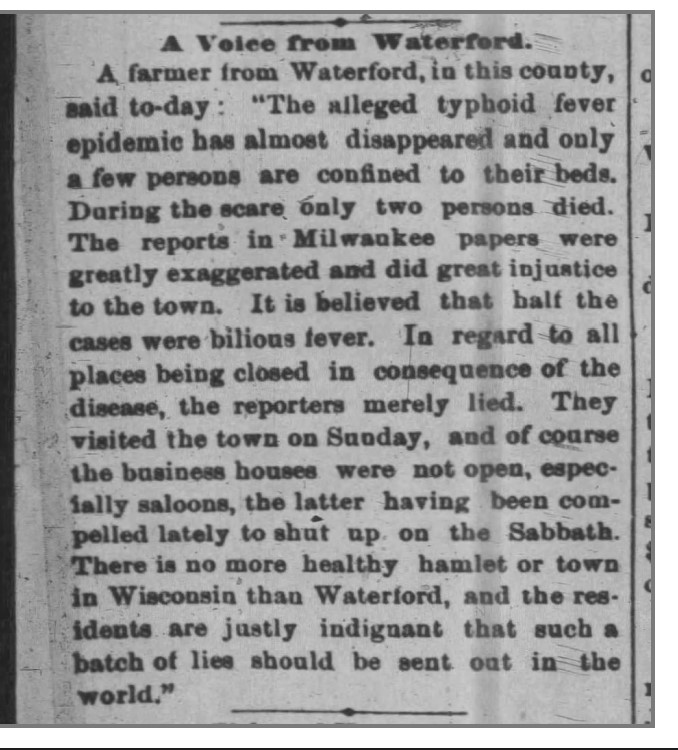
Apparently, The Milwaukee newspapers ran a similar story.

Curtis Barnes Smallpox Death – Alice Barnes Tindal, June 27, 1954, Racine Historical Society
Obituaries of those who died during the epidemics told of the deceased being taken by a horse or ox-drawn wagon at night to the cemetery to be buried as quickly as possible. Imagine the clip-clop sound of a single horse breaking the silence of the night – the rattling of a wooden coffin in the back of a buckboard wagon – knowing that it was probably someone that had succumbed to the disease du-jour – only to wake in the morning to find out who was taken by this awful plague. Waterford was a small village which makes it almost certain that the deceased was known by every resident. It was a frightening time for all who survived, asking the question – am I, or one of my family, next?
Once they got to the cemetery, they had to hand dig a grave by lantern, or moonlight, with a pick and shovel, perhaps in frozen ground which is known for heavy gravel and boulders – and in the harsh elements of the day. Prayers were said after they buried the remains of their loved one and a marker was placed on the grave. Upon returning to their home, grief would have to be expressed in emotional ways and would be permanently embedded in their memory.

Scarlet Fever epidemic as noted in the Burlington Free Press, September, 4, 1873.

1878 Mortality Table for Milwaukee, Wisconsin, The History of Racine ad Kenosha Counties, p.2444. At the time, Milwaukee’s population was 72,000.
Disease was widespread and spared no one, regardless of age or physical fitness. Influenza, then known as ague or the grippe, would wipe out many and occurred virtually every year – some epidemics were deadlier than others. The mortality schedules of the day showed causes of death as consumption (today, known as tuberculosis) and convulsions, instead of ague (today, known as influenza)5. It is now known that high fever can result from influenza and can cause convulsions. Pneumonia was not identified until 1881, yet it exhibited similar symptoms as a bad case of ague. Others are just listed as “Old Age”. Perhaps with today’s technology, the list of “causes of death” may look quite different.
Cholera, Smallpox, Diphtheria and Typhoid… are just a few diseases that would break out from time to time and all that pioneers could do was to wait it out and hope that they would not become infected. Research shows that there were, at times, several epidemics occurring in the country at the same time. Limited travel back then tended to keep epidemics to regional outbreaks.
The following is a list of disease outbreaks in Wisconsin in the 19th century according to The History of Racine and Kenosha Counties:6
1838 – Smallpox.
1841 – Yellow Fever – Wikipedia.com.
1844 – Malaria.
1846 – Malaria.
1847 – Cholera.
– Typhoid.
1854 – Cholera.
1858 – Scarlet Fever.
– Smallpox epidemic – Burlington Standard Press, Aug. 20, 1984.
1864 – Diphtheria – Burlington Standard Press, March 2, 1864.
1865 – Diphtheria.
– Tuberculosis.
– Influenza.
– Pneumonia.
1866 – Cholera – Healthline.com.
1873 – Scarlet Fever – Burlington Free Press, Sept. 4, 1873.
1886 – Typhoid – Waterford Post, July 24, 1886 and Green Bay Press Gazette, July 9, 1886.
Medications, usually home-made, were minimally effective and science had not advanced to the point of proper diagnosis and efficient treatment. Examples from The Letters of Edwin Bottomley7 written in 1847 follows:
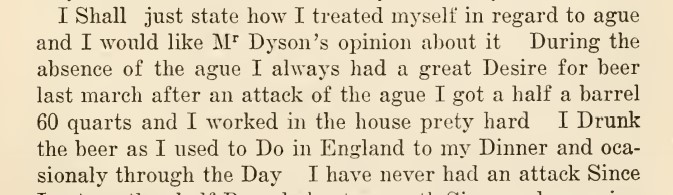
A beer remedy for the flu.
An English Settler in Pioneer Wisconsin8
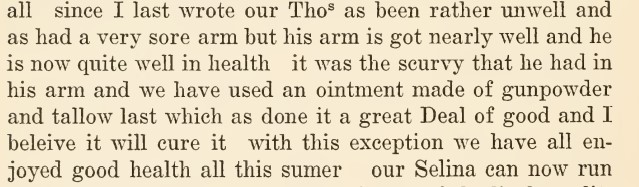
Gun powder and tallow remedy for scurvy.
An English Settler in Pioneer Wisconsin9
A first-person narrative follows family members living in English Settlement, about four miles southeast of Waterford, becoming infected with Typhoid fever in 1847, detailed in the Bottomley letters:10


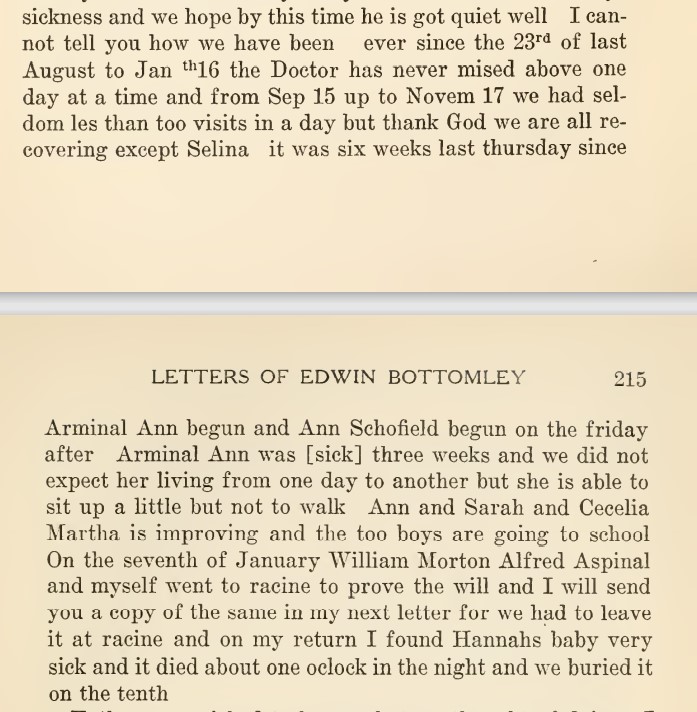
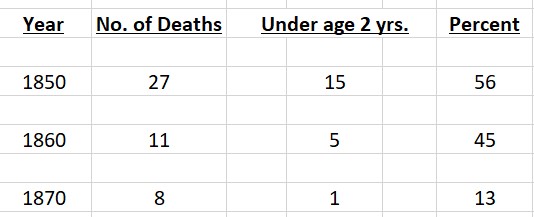
The publication, U.S. Federal Census Mortality Schedules Index, 1850-188011 has a listing of those who died in the year previous to the census along with their age and the cause of death. Only three years are listed for Waterford but it is interesting to note the percentage of deaths of those 2 and younger. Table by R.E. Gariepy, Sr.
The following article is re-typed from the April 26, 1881 Burlington Free Press, describing a tragic drowning death during the flood of 1881. The Waterford Post did not print it since its building was flooded during the incident.
“Sad Death of Miss Betsey Olson (reported by Waterford correspondent)”
“A gloom has been cast over our village by the sudden death of one of our brightest and most promising young ladies, Miss Betsey Olson, daughter of Mr. and Mrs. Halvor Olson, of this village, aged 18 years.
The facts, as far as we can learn them, are these:
Miss Olson, who had been attending the Rochester Seminary for the past few months, started last Thursday morning, in a boat, accompanied by Messrs. Fred. Heitkemper and Chas. Noll, Jr. Her parents did all in their power to persuade her from going but as she had not missed a day, she was determined to go. They reached Rochester in safety, landed near the residence of Mr. Geo. Sharp, from whence Miss Olson at once repaired for the Seminary.”
“The boys went on as far as the bridge, and while there, Miss Olson in company with Carrie Moe, from Waterford (who was also attending school at Rochester), came down to the bridge and finally persuaded the boys to take them for a boat ride. They had gone but a very short distance when a cake of ice struck the boat and frightened the girls who attempted to jump and catch hold of the bridge. In this they failed and the boat was capsized, the occupants were carried under the bridge and down the stream, sinking once or twice beneath the rushing tide.”
“When they arose to the surface below the bridge, Mr. Heitkemper seized the young lady nearest him, which happened to be Miss Moe, and after struggling in the water for some minutes, at length reached the shore in safety. Mr. Noll strove heroically to save Miss Olson, but she was thrown further out into the swift rushing current of the river, and was swept beyond his reach. Finding it useless to attempt to rescue her by swimming after her, Mr. Noll made for the shore which he reached after a hard struggle, too much exhausted to make a second effort. Mr. W. D. White, an invalid, taking in the situation at a glance, plunged into the turbulent stream and soon brought the body of the unfortunate young lady to shore, just above Russell’s mill.”
“She was immediately taken to the residence of Mr. Robertson, and Drs. Lane and G. F. Newell were at once summoned. Dr. Lane soon arrived and did all in his power to resuscitate the drowned girl. He was soon after joined by Dr. Newell and both did all that medical skill could suggest to restore her to life, but all to no avail. She never regained consciousness, and only one feeble pulsation of the heart was observed by the physicians after she was taken from the water. She was brought to this place by team, and carried across the river in a boat, by J. W. Jourdan to her home on the east side.”
The funeral was held on Saturday at 2 o’clock p.m. at her home, Rev. H. B. Lounsbury officiating. At 3 o’clock the body was brought across to the west side of the river in a boat by J. W. Jordan, and put in charge of the Waterford Division of the Sons of Temperance. The division formed in procession at their hall with I. L. Hoover as conductor and marched to the river and as the body was nearing the shore joined in singing, “Shall we gather at the River,” after which the procession marched to the M. E. Church, where the regular form of burial service of the Sons of Temperance was held.”
“The church was filled to its utmost capacity. After the service at the church, the body was taken to the cemetery just north of the village, and we laid our beloved sister in her last earthly resting place.
At the time of her death Miss Olson was Recording Scribe of the Waterford Division of the Sons of Temperance and showed herself a worthy member, and her loss will be deeply felt not only by the Division, but by the community at large.
Her Sabbath School class was also in the procession with the mourning lodge, also a number from Rochester Seminary and Division. It was one of the most solemn and impressive funeral services we ever listened to or witnessed.
The heart-felt sympathy of the community is extended to the bereaved parents in this their hour of sad affliction.”
List of Known Burials
Since there are few marked graves at this site, research through newspapers clips, historical societies’ records, books and online sources was necessary and has resulted in a partial list of probable burials.
As of 2024, 21 tombstones have been found on the site. Some information has been gleaned from the FindAGrave.com website.12 Other information has been uncovered by genealogists associated with the restoration efforts.
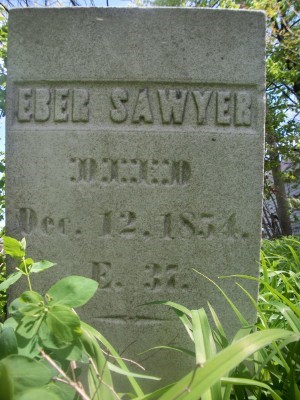
Eber Sawyer, (1817-1854) age 37.
This gravestone was the only one still standing as the restoration work began. It is in excellent condition and can be found on the southwest part of the cemetery.
Eber Sawyer was born in New York. He was the son of Robert Sawyer, a Civil War veteran who owned a homestead adjacent to the cemetery. He married Abigail Austin (1825-1908). Per the 1850 census of the town of Norway, Wisconsin, they had three sons: John, age 6; Robert, age 4 and Eber, a baby.
Everyone was born in New York except Eber who was born in Wisconsin. Thus, the family came to Wisconsin between 1846-1850. In 1860, Abigail was living in Norway, with her children: John, 16; Robert 13; Eber,10; Charles, 8 and Mary, 5. Her real estate was valued at $2,500 and personal $500. In 1870, she was still in Norway with her five children. Her real estate was $6,000 and personal $600. In 1900, Abigail was 80 years old and living with her son Robert, 53, and his family in Waterford. In 1905 she resided with her son Robert, 60; and his family in Waterford.

Abbie M., (Sept., 1876-Feb. 1877 – 5 mo.).
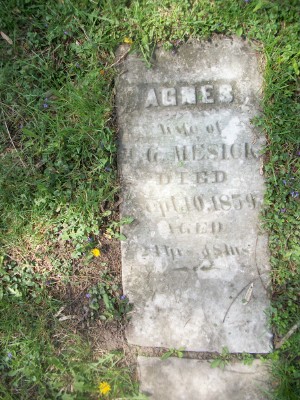
Mary Agnes Mesick, b. Jan. 8, 1835, Duanersburg, NY. d. Sept. 10,1859.
Mary Agnes was known as “Agnes”, and was the eleventh of twelve children of Abraham Wemple and Sophia Vanderpool Wemple. Both of her parents were descendants of early Dutch immigrants who settled in eastern New York state.
Agnes married Henry G. Mesick, (pronounced “Mee’-sik”), on January 18, 1855. They were probably married in the Dutch Reformed Church in Princetown, New York, where her siblings had been married. Normally they would have joined the Lutheran Church in Waterford, as other Dutch settlers had; but they probably joined the Congregational or English Methodist Church if they did not speak German. Both the Lutheran and German Methodist Church services in Waterford at that time were in German.
Henry and Agnes moved to Waterford, Wisconsin possibly intending to farm, although no land purchase has been found. In 1858, they had a daughter that they named Mary Agnes, after her mother.
Agnes, the mother, died a year later, on September 10, 1859, and was buried in the Village Cemetery in Waterford. It is not known how she died, but it was in the year of a smallpox epidemic in Waterford, and many who died of it were buried in “the cemetery on the hill”, as it was known. Her headstone reads: “AGNES/ wife of/ H. G. Mesick/ Died/ Sept. 10, 1859/ Aged/ 24 yr and 8 mos.”.
After her death, Henry moved back to New York with their daughter.

Philip F. Mitsch, b. Oct. 1859, Waterford, WI. d. Feb. 19, 1863, Waterford.
Philip was the son of Johan and Johanna Noll Mitsch. the second of four children. His middle name was probably “Friedrich” after his mother’s father. His father, Johann Philip Mitsch, called “Philip”, was born in Baden, Germany in 1823; and his mother, Johanna (Hannah) Christina Noll, was born in Baden, Germany in 1830. Johann was “a laborer” according to the 1860 census. They were Lutheran in Germany but records indicate that they were members of the German Methodist Church in Waterford, as services were in German.
Young Philip died on February 19, 1863 of now unknown causes; and he was buried in the Village Cemetery. His gravestone reads: “Philip F./ Son of/ Philip & Johanna/ Mitsch/ Died/ Feb 19, 1863/ 3 yrs. & 4 mo.”. His stone is broken in two pieces.
His parents and other family members are buried in Waterford’s Oakwood Cemetery. There are still descendants of the Mitsch family in Waterford.
Philip’s headstone was one of at least two removed from the cemetery by vandals in 1955. It was discovered on Highway 36 near Waterford, and was returned to the cemetery by Police Chief Pat O’Connor, as reported in the Racine Journal Times on April 18, 1955. The other headstone removed and returned was for young Abbie Sawyer.

Lucretia Major, b. 1810, NY. d. Dec. 19, 1844.
Lucretia and her husband, J.C., moved to the Waterford area from New York, where they were probably married sometime after 1826, the year she was sixteen. They must have arrived in Racine County after the 1840 census, as they do not appear on it. J. C. must have moved away after 1844, as he does not appear in the area after her death.
There is no record of her maiden name. There was no mortality schedule in 1844, and no obituary has been found. The Major’s were probably Congregational or Methodist. Her headstone reads: “Sacred/ to/ the memory of/ Lucretia wife of/ J.C. Major/ Who died 18th Dec./ 1844/ Aged 34 years/ From the state of N. Y.”
The stone is broken in half. On the bottom half is a slight variation of the first verse of a poem by English Congregational minister Isaac Watts. The hymn is titled “Why Should We Start, and Fear to Die?”as first published in Watts’ book, Hymns and Spiritual Songs, in 1707.
“She did not start or fear to die
As amorous mortals do.
She lived in hope of joys on high,
And died with them in view.”

Hiram Page, b. between 1809 and 1812, Oswego Co. NY. d. Sept. 13, 1881, Waterford.
His gravestone is very weathered and was only partially visible when uncovered in the cemetery restoration project in April, 2022. A carved symbol at the top of the stone with an index finger pointing upwards indicates that he has gone to heaven. This was a common motif of the early nineteenth-century headstones. The stone reads: “Hiram Page/ Died Sept. 13, 1881/ Aged 72 yrs.
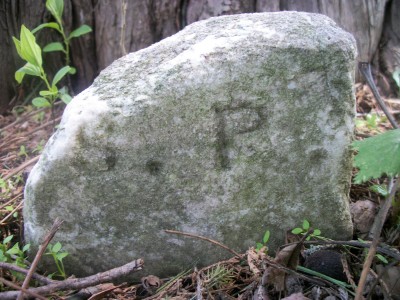
Sarah Jane (Sally) Barnes Page, b. 1812, Lewis Co. NY, d. May 30, 1875, Waterford.
Sally was the daughter of Levi and Lewey Barnes, one of the founders of Waterford. She married Hiram Page in 1833 and settled in northern Indiana for a few years before moving on to Wisconsin in 1836. They were one of the very early pioneers of Rochester Twonship, later Waterford. Hiram and Sally had five children. Sally died of nephrin feaver, a type of kidney infection, commonly tied to typhoid. A son, Hiram, Jr., was also buried in the Old Village Cemetery, but no marker has been found.
Hiram Page, Jr., No gravestone. Infant son, died September 1, 1837. Listed as first burial in Old Settlers Cemetery. Son of Hiram and Sally Jane Barnes Page, Grandson of Levi and Lucretia Barnes.
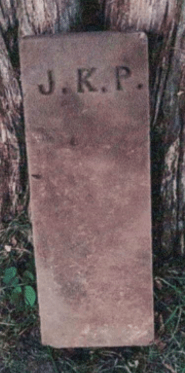
Jane Kirkpatrick Page, b. 1815, Ireland, d. May 30, 1875, Waterford.
Jane was the second wife of Hiram Page, having married on Dec. 25, 1850. They had one son, Philo, in 1852. Jane died May 30, 1875 after 25 years of marriage and was buried next to husband Hiram. Her grave marker was a simple stone with her initials “J. K.P.”

Jane Ann Robinson Rice, b. 1812, VT, d. Mar. 30, 1860, Waterford.
Born 1826 in Vermont, Jane married Edwin A. Rice on June 9, 1852 in Racine. Edwin was born Oct. 10, 1816 in New York. His occupation was a carpenter/joiner. Their only child was Clarence Edwin Rice (1854-1943). Jane Rice is listed on the 1860 Mortality Schedule for Waterford as died from consumption (tuberculosis-1 yr.).
Her gravestone reads: Jane A./Wife of Edwin A. Rice/ Died Mar. 30, 1860, AE 34 yrs.

John F. Beedle, Sr., b. June 7, 1787 Schodack Township, NY – d. May 10, 1850 Rochester Township, WI
John F. Beedle was the son of John Beedle, a Revolutionary War veteran and blacksmith, who leased a farm in Schodack Township after the war, but later moved to Long Island, NY. John F. grew up there, and met and married Nancy Ann Lighthall in 1811.
In the War of 1812, John F., also served as a blacksmith, a much-needed skill at the time, and was a member of General Farmington’s Regiment, New York Militia, until near the end of the war, when he enlisted in the US Army and served in the Ordnance Department.
He and Nancy Ann had a family of thirteen children in Long Island and Madison County, NY before moving to a farm in Rochester, later Waterford Township, Wisconsin between 1840 and 1843. They attended the Methodist Church.
John F. Beedle, Sr. died of consumption, (tuberculosis), on May 10, 1850 according to the 1850 Rochester Census Mortality Schedule. His headstone reads: “John F. Beedle/ Died/ June 10, 1850/ AE 63 years”. The month is incorrect. If he had died on June 10th, he would have been listed on the June 1, 1850 census, and not on the Mortality Schedule for May.
Only one of John and Nancy Ann’s thirteen children, John F. Jr., is buried in Waterford. It does not appear that any of their descendants still live in the Rochester/Waterford area.

Theron Lavern Beedle, b. September 22, 1849 Rochester Township, WI – d. August 16, 1850 Rochester Township, WI
Theron Lavern Beedle was a grandson of John F. Beedle, Sr. His parents were Joseph Lighthall Beedle, (the second son of John F. and Nancy Ann), and Emeline Barker, who were married in New York in 1842. They moved to a farm in Rochester Township, Wisconsin shortly after. They were the parents of eight children.
Their first four children were born between 1843 and 1847. All four died between the ages of one and three before 1848 and may have been buried in the Waterford Village Cemetery, although there are no grave markers for them. Or, as they died in the early 1840’s before the cemetery was well established, they may have been buried on the family farm in Rochester Township.
Their younger brother, Theron Lavern, called “Lavern” was born in 1849, and sadly, he too died less than a year later. He was buried near his grandfather, John F. Beedle, Sr. and uncle, John F. Beedle, Jr. His headstone reads: “Theron L./ son of/ Joseph L./ Beedle/ died Aug/ 16, 1850./ AE 11 mos.” It is not known how he died. His headstone was uncovered on September 16, 2021 while clearing brush during the cemetery restoration project.
Soon after Theron died, his parents moved to Seven Mile Creek in Juneau County, Wisconsin, where his father became the postmaster. Three more children were born to them, and all survived into old age.
There are no descendants known to be living in the Waterford area.
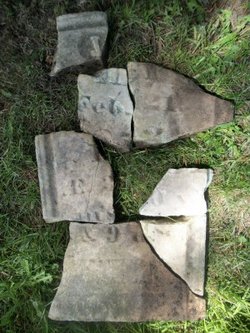
James Ricker, (1821- February 21, 1852) age 31.
James Ricker was born in 1821 in Vermont per the 1850 census of Waterford, WI. He was a 28-year-old farmer and lived with the Joseph Caldwell family and eight others.
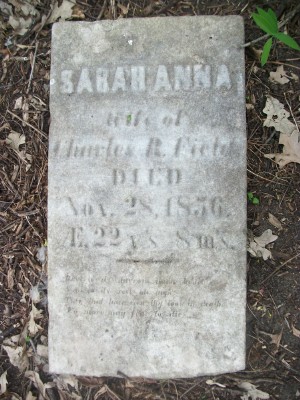
Sarah Anna Field, b. abt. March 28, 1834 – d. November 28, 1856 Waterford, WI
“Dust to its narrow home beneath,
Soul to its rest on high,
They that have seen thy look in death,
No more may fear to die.”
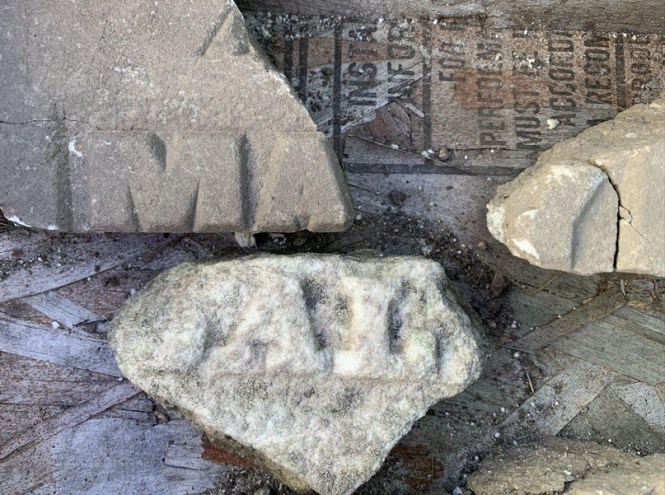
Sarah (Sally) Perry Flint, b. April 29, 1791 New Haven, NY – d. August 10, 1856 Rochester Township, WI
Daniel and Sally Perry Flint moved to Rochester, Wisconsin in 1842 with their five children, Ansel, Sarah O., Susan Loretta, Daniel Perry, and Caroline Perry.
After Daniel died on October 2, 1848, Sally continued to live on the family farm with their grown children, Sarah, Susan, Daniel Perry, and Caroline and their spouses. They probably belonged to the Congregational Church in Waterford. Sally Perry Flint appears on the 1850 and 1855 Rochester/Waterford census reports as “Faly” Flint.
Sally died in 1856 and was buried next to Daniel in the Waterford Village Cemetery, but her headstone has been destroyed, and only fragments remain. Daniel’s grave was removed years later and re-interred in the Rochester Cemetery, but Sally’s apparently was not. Daniel’s original headstone is lost, but a new one was placed in Rochester Cemetery after his grave was moved.

Ebenezer (Eben) Flint, b. Hampton Township, Vermont, August 7, 1792 – d. June 25, 1877, 84 years.
When he was twenty, he is thought to have served in the Vermont Militia with his older brother, Daniel Flint, Jr., and his Flint cousins in the War of 1812. All young men at the time were required to serve in the Army or Militia. Their unit, the Edward Fifield Vermont Militia, guarded the Canadian border against invasion by the British.
Eben married Elizabeth Linfield in 1822 in Braintree, Vermont, where he was employed in manufacturing. They moved to Genesee County, New York, where their seven children were born, and from there to a farm in Rochester Township between 1840 and 1842. They were members of the Congregational Church.
Eliza Linfield Flint, b. Oct., 1803 – d. June 2, 1879, 75 years.
After Eliza died, a double stone with Eben’s inscription on the left and Eliza’s on the right was placed in their memory. At the top is the nineteenth-century cemetery symbol for marriage and everlasting love, two hands clasping. Symbolically, Eben’s hand is on the right holding Eliza’s hand, (in a frilly cuff), indicating that he had died first and would guide her to heaven. On the left side of the stone is inscribed “Eben Flint/ Died/ Jun 23, 1877/ Aged/ 84 Yrs 10 M’s”. Underneath is inscribed “Gone but not forgotten” across both sides of the stone.
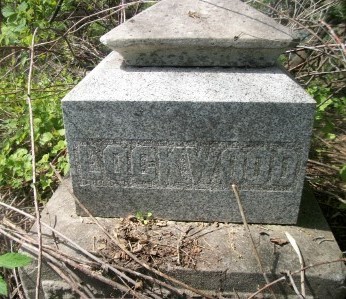
Alfred Lockwood, b. Aug. 12, 1822, Ogdensburg, NY. d. Oct. 18, 1878
Alfred, son of the Revolutionary War veteran, Jonathan Lockwood, moved from New York to Akron, Summit County, Ohio in 1834, and then to Waterford, Wisconsin, in 1836, according to a history of Racine County.
On May 7, 1846, Alfred married Lucy C. Powell in Mukwonago, Wisconsin. Alfred, a carpenter and joiner, later millwright, and Lucy, purchased a farm in Rochester Township. In 1852, Rochester Township split into two townships—Rochester and Waterford, and their farm was then in Waterford Township. They raised three daughters, Adelia, Alice, and Florence. Their only son, Charles Alfred, died in October 1856.
Alfred participated in local government, and served as Justice of the Peace and Assessor for the Town of Waterford. The Lockwoods probably belonged to Waterford’s English Methodist Church.
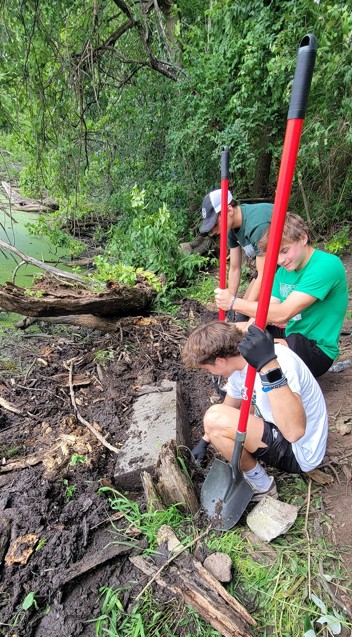
Alfred died, after a long illness, at the age of fifty-six. In July of 2023, a large and heavy gravestone was pulled from the edge of the pond by the Waterford High School football team. It was Alfred and Lucy’s headstone, and while it had been under branches and water for many years, it was in perfect condition. A heavy square base with LOCKWOOD carved in it was in what appears as a family plot. The 800-pound cross vaulted obelisk was originally placed on top.

Lucy Powell Lockwood b. Aug. 2, 1826, Hornellsville Township, NY. d. Sept. 8, 1885, age 59 yrs.
Lucy married Alfred Lockwood on May 7, 1846 in Mukwonago, Waukesha County, Wisconsin. They purchased a farm in Rochester/Waterford Township, where they lived with their four children.
After Alfred’s death in 1878, Lucy lived with her daughter, Alice, and son-in-law, George Newcomb, in Waterford. Lucy died on September 8, 1885, of Bright’s Disease, in Owosso, Michigan while visiting her daughters Adelia Martin and Florence Lockwood. According to her obituary, her body was sent by rail for burial in the Waterford Village Cemetery next to Alfred in their family plot. Her inscription on the shared headstone reads: “LUCY/ his wife/ Born/ Aug 2, 1826/ Died Sep 8, 1885.”

Charles Lockwood, b. 1853, d. October 30, 1856, 3 yrs.
Son of Alfred and Lucy Lockwood., Charles was the third of the four children, and the only son. He died of unknown causes at three years of age and was buried in the family plot at Waterford Village Cemetery. His headstone inscription reads: “Charles A./ Son of/ A.& L. Lockwood./ DIED/ Oct. 30 1856./ AE 3 yrs.”
Also inscribed on the stone is a verse of the poem, “Safe in the Arms of Jesus”, by the American poet, Fanny Jane Crosby:
“Rest little sufferer rest
Thy sufferings here are done.
Safe lodged in Jesus’ breast
Thy Savior took thee home.”
This headstone disappeared from the Waterford Cemetery decades ago and was recently found in a shed at St. Peter’s Cemetery in the Town of Waterford by two of the cemetery restoration volunteers. It is being returned to its original location.
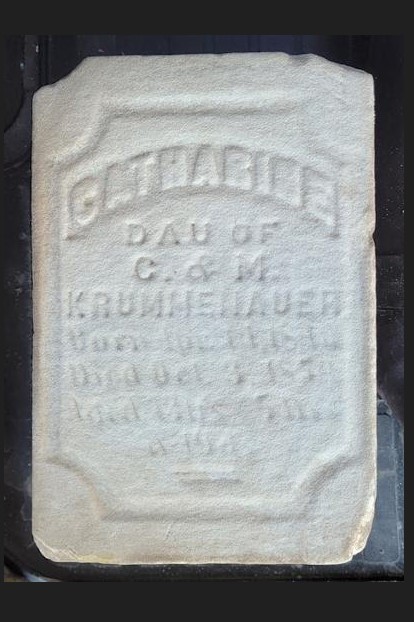
Maria Catherine Krummenauer, b. Apr. 14, 1840, Oldenburg, Germany. d. Oct. 3, 1853, Age 13 yrs. Reinterred at Oakwood cemetery.
After the death of their first child, Charles Krummenauer, and his wife, Maria, came to America in 1843 with their three-year-old daughter, Maria Catharine, to seek better economic conditions. They worked to earn enough money to buy a farm, and in 1850 purchased land in Norway Township, Racine County. They built their farm, and became prosperous and respected members of the community. Charles held the office of Pathmaster for four terms, overseeing the building and maintenance of roads in the township. They were members of the Lutheran Church. Their daughter attended the local township school.
Catharine died in Norway Township. It is possible that she contracted cholera or typhoid, which were epidemic in the area around that time. She was buried in Waterford’s Old Village Cemetery. Her gravestone was lost over time, until in August of 2022, when it was located during the cemetery restoration project, covered by debris, but in good condition. It is a heavy marble stone, almost cubic in shape, 15” x 10” x10”, which once had a cap or obelisk on top.
It reads: “CATHARINE/ Dau of/ C. & M./ KRUMMENAUER/ Born April 14, 1840 / Died Oct 3, 1853 / Aged 13 yrs., 5 mos./ & 19 days

William Lawrence Bent, b. May 12, 1806, Wendell, MA – d. January 3, 1855 Waterford, WI
On March 15, 1843, William married Mariah Hannah Woodbury, of Leverett, Massachusetts. They had two sons, Joel and William. In 1849, they moved with their four children from Massachusetts to a farm in Rochester Township, Racine County, and two daughters, Lydia and Emily were born to them there. The 1850 census shows that William was a farmer, and very well-off. He may have also worked as a stonemason in the Waterford area. The family presumably attended the Waterford Congregational Church, as William had been a deacon in Massachusetts.
After six years in Wisconsin, William Bent died in Waterford in 1855 at the relatively young age of 48, of unknown causes. His headstone reads “William L. Bent./ DIED/ Jan. 3. 1855/ AE 48.”. After William’s death, his widow, Mariah, sold the farm and moved back to Leverett, Massachusetts with her four children and her step-daughter, Lucinda.

Sarah Susannah Taylor Price Foat, b. Sept. 6, 1808, Kent, England – d. August 30, 1893 Waterford, WI
Sarah was baptized in St. Mary’s Church, Kent, England in 1808, the daughter of George Taylor and Mary Thomas Taylor. She first married a Mr. Price. Sarah married a second time to Richard Foat in Kent, England on August 1, 1830.
Sarah and Richard emigrated to America in 1833 with their three children, Daniel, Samuel, and Mary Jane, and lived in Schenectady, New York for ten years. Three more children were born there, Susannah, Edward, and Pauline. In 1843, they moved to a farm in Rochester Township, Racine County and had three more children, Francis, Perlina, and Andrew. The family belonged to the Methodist Church in Waterford.
Two of their daughters, Pauline and Perlina died young and were buried in the Waterford Village Cemetery. Their son, Francis, died in 1891, two years before his mother, and is buried in the Rochester Cemetery.
Sarah died just one month after her sixtieth wedding anniversary, and was survived by her husband, Richard, six children, thirty-one grandchildren, and twenty-one great-grandchildren. Her grave marker reads “SARAH / Wife of Richard Foat / Died Aug 1, 1893 / Age 84 YRS 11 MOS”. The marker is incorrect, as August 1 was the date of their wedding anniversary. She died on August 30th as per her obituary, which was published less than a week after her death.
Her husband died three years later and was buried in Rochester Cemetery. A cenotaph for Sarah was added to Richard’s gravestone there.
There are still descendants of this Foat family in the Rochester/ Waterford area.

Edward D. Foat, b. Aft. June 1, 1860 Waterford. – d. 12 Oct 1863 Waterford.
Edward’s exact birth date is unknown. His father, Daniel Samuel Foat, was born in Kent, England in Jan 1829 and emigrated to America in 1850. Daniel briefly settled in New York, where he married Hannah D. Foat, a first cousin, who was born in New York in 1827.
Daniel, a carpenter, and Hannah moved to Waterford, Wisconsin by 1855. They had five children, Charles S., Eva, Harriet, Edward D., and Amy, all born in Wisconsin. The family belonged to the Waterford Methodist Church. Daniel served in the Civil War from 1862 to 1865 in Wisconsin’s 22nd Infantry. After the war, and the death of his youngest son, Daniel and Hannah moved their family to Sharon, Pennsylvania; and none of their descendants are known to be living in the Waterford, Wisconsin area.
Young Edward died in 1863 in Waterford. Only the top half of his headstone has been found. It reads: “EDWARD D./ Son of/ D.S. & H. /FOAT/ Died/ Oct? 12, 1863”. (The break is through the date. The month appears to be October, and his age is not visible.)
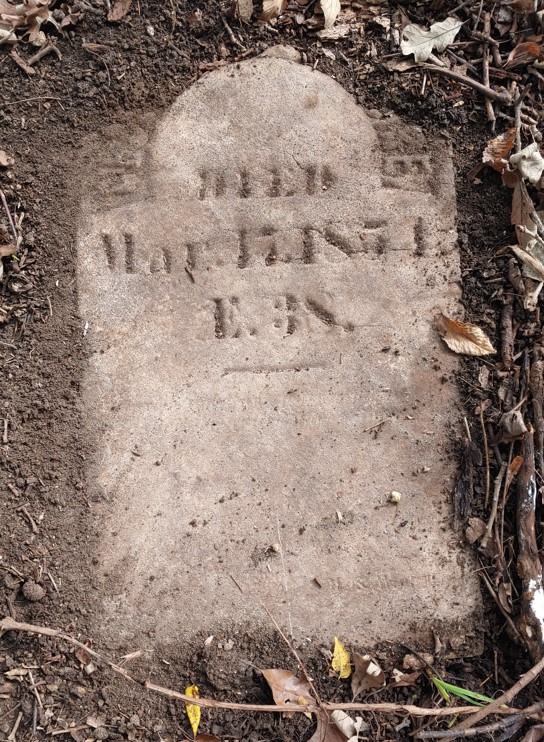
George Waltermire, b. Abt. 1815/16, Ghent, NY. – d. June 15, 1869, Norway Township, WI
George was born in Ghent, New York, along the Hudson River, son of farmer George Waltermire, Sr. and Cornelia Hallenbeck, both early Dutch settlers. George married Lydia Ximena Arnold on March 21, 1839 in West Stockbridge, Massachusetts.
In 1846, George and Lydia moved to Wisconsin and bought two parcels of land in Norway Township – 80 and 40 acres. George quickly became well known in the area and within five years was appointed to the County Vigilance Committee, Racine County Agricultural Society Committee and became Postmaster at Wind Lake. George and Lydia donated the land for the Norway District #3 schoolhouse which was built on the site and names the Waltermire School.
George died at the young age of 38 years of unknown causes after only eight years in the area. It is speculated that he was a victim of the cholera epidemic sweeping the area at the time. His stone reads: “George Waltermire/died Mar. 17, 1854/AE 38”.

Lydia Ximena Waltermire, b. Feb. 13, 1815, West Stockbridge, MA – d. June 15, 1869, Norway Township, WI.
Lydia was the daughter of Alvan and Mary Arnold and was the eldest of nine children. She went by her unusual Spanish middle name of Ximena (pr. Him-may-na). George married Lydia Ximena Arnold on March 21, 1839 in West Stockbridge, Massachusetts.
George and Lydia did not have any children. Lydia died fifteen years after her husband George and her headstone, which is next to his, reads: Lydia Ximena/ Wife of/ Geo. Waltermire/Died/June 15,1869/Aged 54 Years.
Both George and Lydia’s headstones were lost in time but rediscovered during the cemetery restoration project in 2022. They were buried in the dirt under the west side of the large old Oak tree located in the southwest corner of the cemetery. The headstones have been moved to the east side of the tree for visibility.
List of Reinterments
The following list of names are known to have been buried at Waterford Village Cemetery and have been reinterred at other cemeteries as noted. A survey has been made of the Oakwood Cemetery gravestones and listings on Find-A-Grave.com to determine the death dates. Since land for the Oakwood Cemetery was not purchased until May, 1857, any tombstones with earlier death dates are considered as reinterments from the Waterford Village Cemetery. Other cemeteries are still being surveyed for additional information.
Andrew Braddock Jones, (1817-1853) age 36. Re-interred at Oakwood. A. B. Jones, as he was known, was an early pioneer from Elba, New York and came to Waterford along with his younger brother, Eli Moses, by 18429. In 1843, Eli purchased several large pieces of property in Waterford consisting of; Blocks 8 and 11, which is bounded by Main, Washington, Jefferson and Water streets, and Block 21, which consists of 15.63 acres. It is the land north of and behind the stores on east Main – from the Fox River to Milwaukee Street, north to the present marina. The purchase included water rights.
The brothers built a Mill and a distillery on the east side of the river. A concrete abutment is still in the stream, perhaps as part on the dam where the mill was located. On March 23, 1847, Eli sold all his property to his brother Andrew and joined his father in Janesville for a short time. Eli then returned to his home town of Elba, New York where he spent the remainder of his years farming. He died in 1882.
In addition to the land purchased from his brother, Andrew purchased the southeast corner lot between the present day Enve’ Salon & Day Spa and North Water street in 1843. After he bought Eli’s Block 8 property, he built a brick home across Main Street on the adjacent property west of the Mealy Funeral Home. It is mentioned in several publications that he planted the remainder of the blocks with apple trees and it became known as Jones Apple Orchard. It is unknown if the original home is under the current siding on the home that is currently there.
A.B. Jones and his wife, Lodema, had two children, Amos and Emeroth, who died at very young ages. Unfortunately, one of the pioneer diseases also took the father at a relatively young age. Lodema continued to manage the estate for about 10 years until she married John Groat. A.B. Jones Last Will and Testament stipulated, in the event of re-marriage, she would have to transfer two-thirds of the real estate to his sister’s children, whose married names were Polly Bemis and Loranda Whitney. Block 21 was subsequently subdivided and became known as the Bemis and Whitney subdivision on all future land documents. Reference is made to the preceding map.
Child Adams – No gravestone. Records indicate infant death in 1853. Reinterred at Oakwood.
Diana Ann Boughton – (1823-1850) age 27. Reinterred at Oakwood.
Benoni Buttles – (1804-1856) age 52. Reinterred at Oakwood.
Mary Gibbs – (1771-1849) age 78. Reinterred at Oakwood.
Eliza Groat – (1816-1857) age 41. Wife of John Groat. Reinterred at Oakwood.
Nancy Hulburd – (1826-1850) 24 yrs. Reinterred at Oakwood.
Amos B. Jones – (1843-1845) age 2. Son of A.B. Jones. Reinterred at Oakwood.
Emeroth J Jones – (1847-1850) age 3. Daughter of A.B. Jones. Reinterred at Oakwood.
Dwight Moe – (1847-1851) age 4. Son of Charles and Emily Moe. Reinterred at Oakwood.
Willet Moe – (1851) Infant. Son of Charles and Emily Moe. Reinterred at Oakwood.
Alexander Hamilton Morgan, Jr. – (1850-1852) age 2. Reinterred at Oakwood.
DL and LL Noll (April 12, 1842) Apparent infant twins. Reinterred at Oakwood.
Esther Jones Palmer – (1823-1847) age 24. First wife of Nelson Palmer. Reinterred at Oakwood.
Rachel Palmer – (1781-1852) age 71. Mother of Nelson Palmer. Reinterred at Oakwood.
Frost Powell – (1768-1847) age 79. Reinterred at Oakwood.
Asa Powell – (1814-1850) age 36. Son of Frost and Rebecca Powell. Reinterred at Oakwood.
David C Sproat – (1795-1869) age 74. Reinterred at Oakwood.
Sarah Sproat – (1800-1874) age 74. Wife of David Sproat. Reinterred at Oakwood.
Edward Sproat – (1829-1846) age 17. Son of David Sproat. Reinterred at Oakwood.
Esther Sproat – (d.1847) Reinterred at Oakwood.
Milton Weage – (1847-1847) age 2 mos. Son of Harvey Weage. Reinterred at Oakwood.
Albert Weage – (d.1851) age 1 yr.- 2 mos. Son of Harvey Weage. Reinterred at Oakwood.
Hester Wilde – (1854-1856) age 2. Reinterred at Oakwood.
Anson Willard – (1787-1850) age 63. Reinterred at Oakwood.
William Williams – (1788-1856) age 68. Reinterred at Oakwood.
The following names were mentioned in newspaper articles or historical documents as being originally interred here but not included above:
Samuel E. Chapman (1808-1872 age 64. Re-interred at Rochester June, 1897. Details on Founder’s page.
Harriet Barnes Chapman (1807-1885) age 76. Re-interred at Rochester, June, 1897. Details on Founder’s page.
Freddie D. Chapman, (1867) Infant son of Chauncey and Emily, Re-interred at Rochester.
Gertie Chapman, (1868) Infant daughter of Chauncey and Emily Re-interred at Rochester.
(2 other Chapmans related per the Burlington Free Press, June 30, 1897).
Levi Barnes (1774-1849) age 75. Re-interred at Rochester. Details on Founder’s page.
Lewey Barnes, wife of Levi (1784-1839) age 55. Re-interred at Rochester. Details on Founder’s page.
Curtis Deforrest Barnes (1823-1859) age 36. Re-interred at Rochester. Son of Hiram Barnes.

Richard Short, born 1818 in Virginia, enlisted in Co. E on Jan 26, 1862, died during the Civil War on March 7, 1865 in Libby Prison in Richmond, VA. He was a corporal in rank. He was married to Martha Amelia Barnes, daughter of Levi Barnes, February 13, 1840 in Waterford, Wisconsin. She died in 1861. They had three daughters and a son, none of whom were buried in Waterford. It would make sense that Richard and Martha were buried in the Old Village Cemetery, since they would be buried there with the rest of the Barnes family at the time. The family, including Richard and Martha, was re-interred in the Rochester Cemetery probably in the 1870’s or 80’s. Photo from Wisconsin Digital Archives.
Samuel C. Russ (1800-1860) age 60. Re-interred at Rochester – Gravestone shows “Rust”. It is unclear why the tombstone for the Russ’ is inscribed as RUST. All legal documents with their name are spelled as RUSS. Details on Founder’s page.
Adeline Barnes Russ (1809-1863) age 54. Re-interred at Rochester – Gravestone shows “Rust”. Details on Founder’s page.
Stephen Russ (1844-1863) age 19. Re-interred at Rochester – Gravestone shows “Rust”.
Betsey Olson (1863–1881) age 18. Lydia Carr Remembers Waterford Post Jan. 8, 1929.
Joshua Woodhead – Re-interred at Oakwood Lydia Carr Remembers Waterford Post Jan. 8, 1929. Details on Heritage Homes page.
Libbie Woodhead – Re-interred at Oakwood Lydia Carr Remembers Waterford Post Jan. 8, 1929.Details on Heritage Homes page.
Lewis D. Merrill – Re-interred at Oakwood Lydia Carr Remembers Waterford Post Jan. 8, 1929.
Albert Foat (1862-1865) age 3. Re-interred at Rochester.
The following names are mentioned as being buried here in a June 27, 1954 presentation to the Racine county Historical Society made by Alice Barnes Tindall, (1883-1975) the great, great, granddaughter of Levi Barnes. The names are as she remembered as she walked through the cemetery in her earlier years. The names are noted as “above” if they are already accounted for.
Levi Barnes – above
Lewey Barnes – above
Samuel E, Chapman – above
Harriet Chapman – above
Samuel Russ – above
Adeline Russ – above
Foats – above and some probably re-interred at the family plot at Rochester.
Sutton’s; possibly Jonathon (1802-1871) age 68; Aleck (1836-1861) age 25; Edward (1841-1862) age 21. Re-interred at Rochester.
Temples – unknown
Mitschs – above
Eber Sawyer– above
Berger’s – unknown
Hiram Barnes – above
Joshua Woodhead – above
Alfred Lockwood – above
Hiram Page – above
Sally Jane Page – above
Lewis D. Merrill – above
Restoration Work
Research and writing began in 2018 to document the history of this hidden and forgotten village site. As with all research, one discovery leads to another. The original scope of the committee’s work was to just document the origins and establish an historical marker and memorial gate. Only a small area was visible from Riverside Drive but the original 1843 survey showed a much larger area as the dedicated site.
In January 2020, it was decided to clean up the site. A meeting was held with an archeologist from Wisconsin Lutheran College to assist in an orderly plan, with proper coordination with the Wisconsin Historical Society. WHS has lawful control over old burial sites and permissions must be applied for and granted before disturbing the site.
Unfortunately, the 2020 COVID pandemic postponed plans until after it was over. During the interim period, permissions were secured and coordination with the Village was established.
During the summer of 2021, several volunteers proceeded to clear the upper part of the site, exposing only one standing tombstone – Eber Sawyer. Nineteen others were found broken lying flat on the surface or partially exposed. All locations of the fragments were mapped with coordinates, boxed up, and removed for cleaning, repairing and re-installation when the burial plots are identified. The remaining unidentified locations of found stones will be displayed in accordance with WHS guidelines.


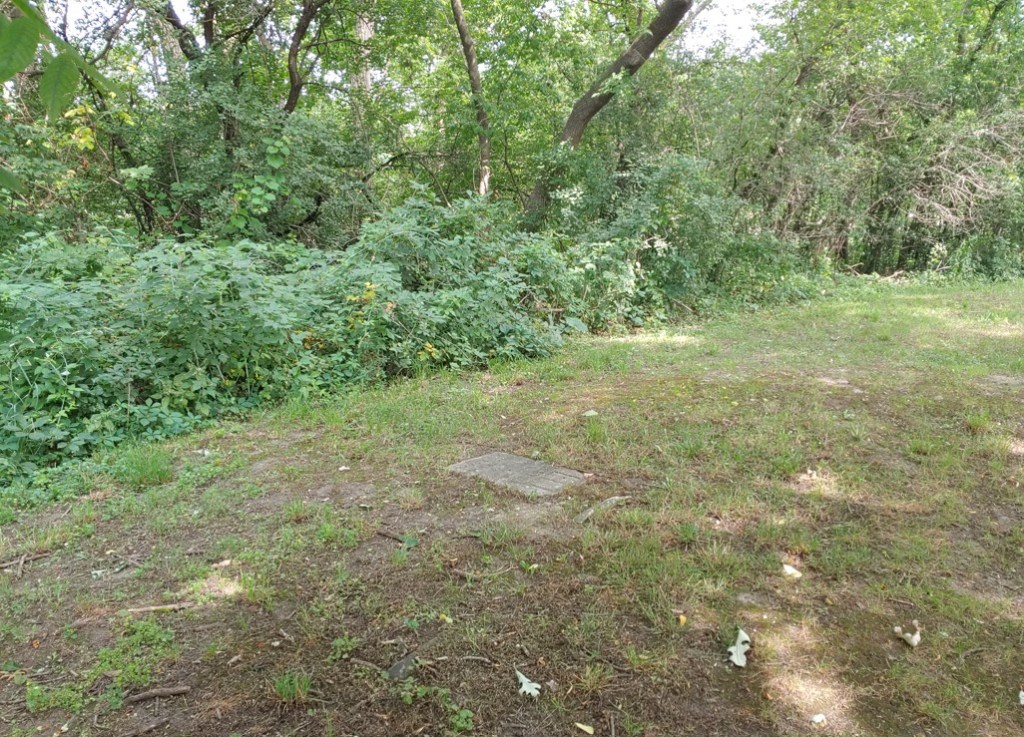
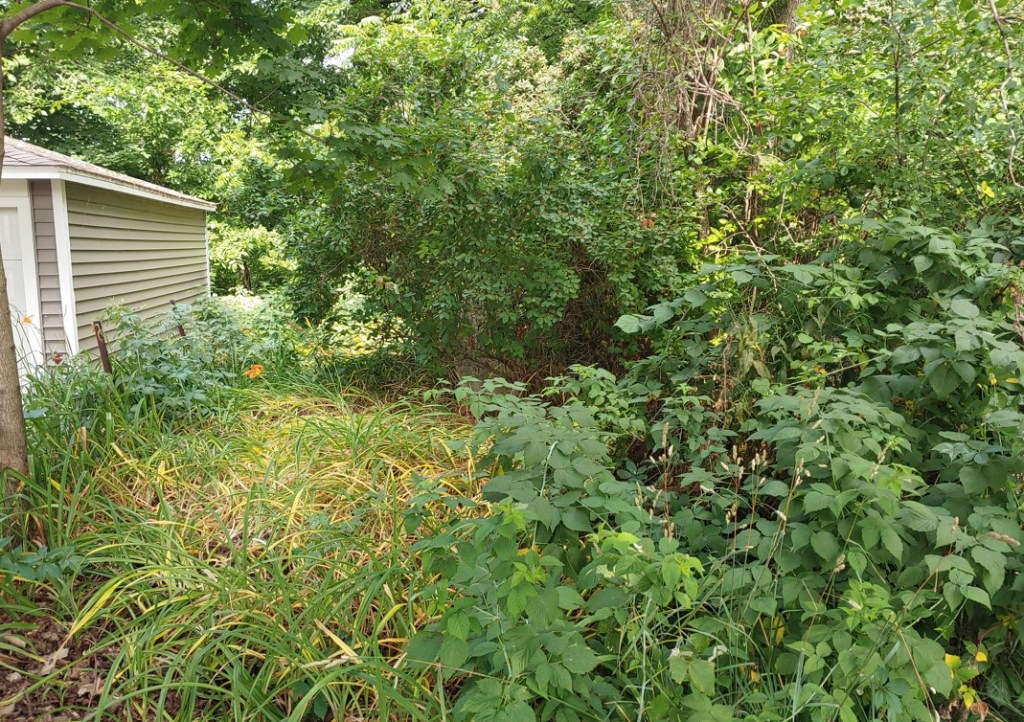
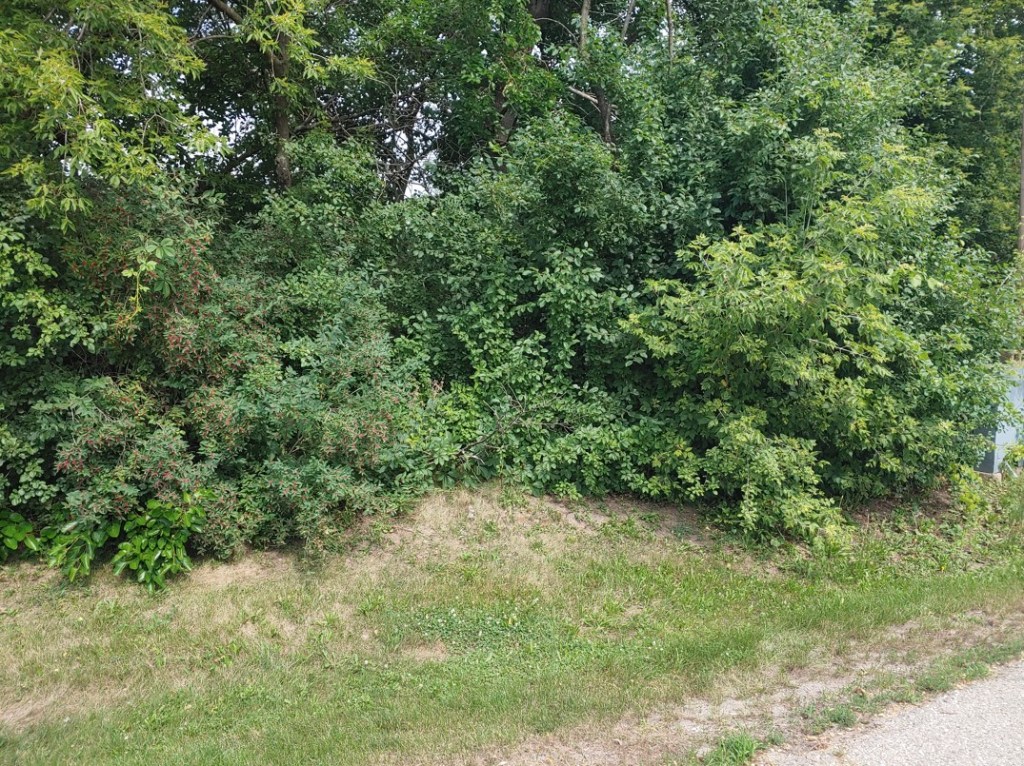


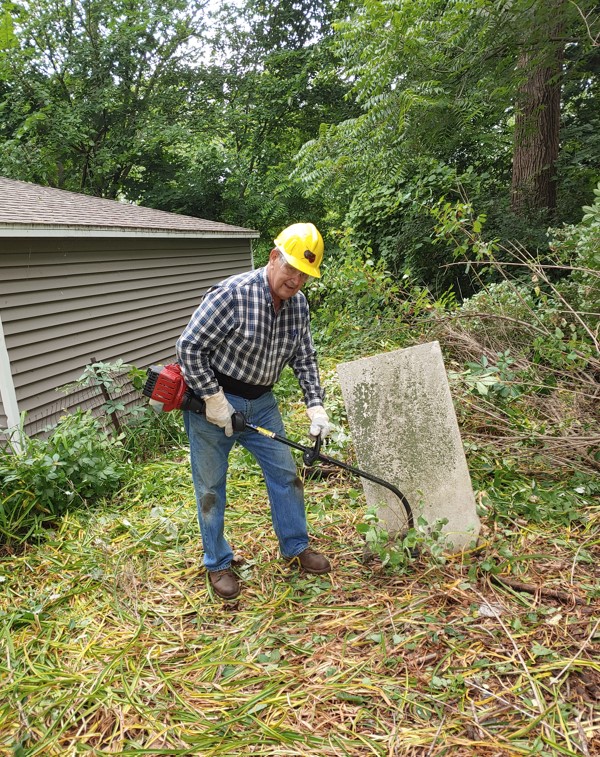

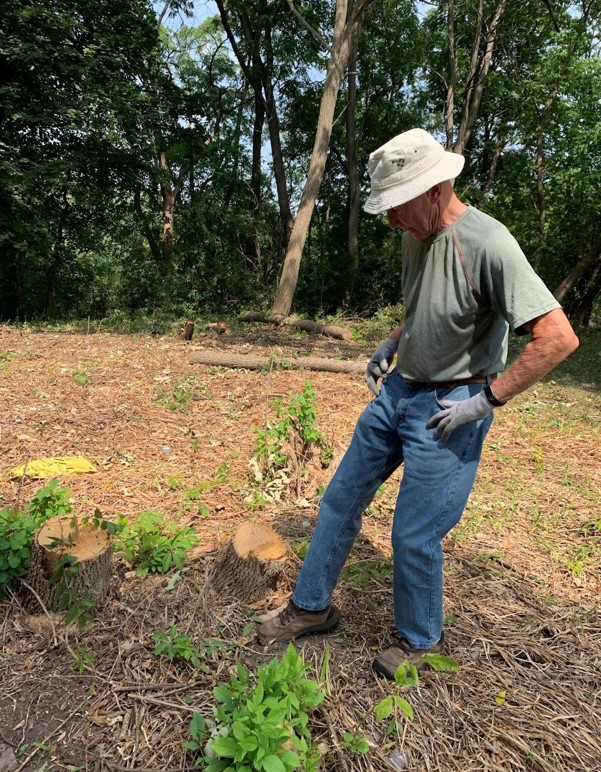


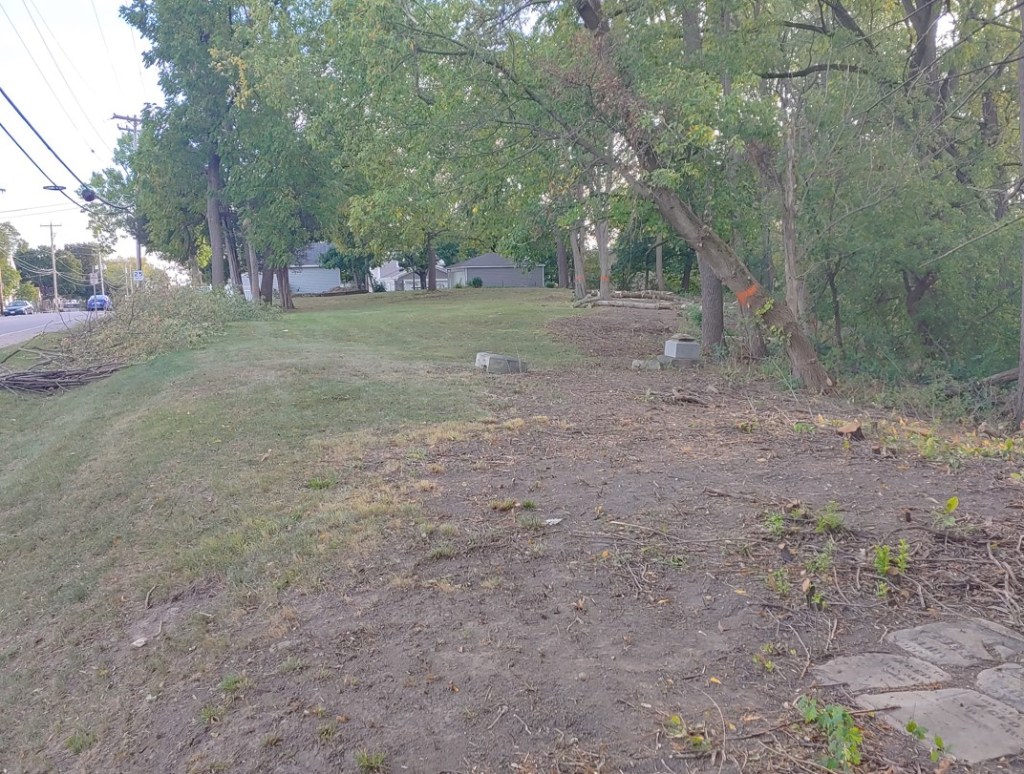

Archaeologists from Milwaukee Lutheran College brought in high-tech, ground-penetrating radar (GPR) to survey the site and identify the actual burial spots. GPR can identify disturbed earth consistent with a burial signature. Some reinterments were done at other local cemeteries while others are presumed still buried there based on available records noted above.

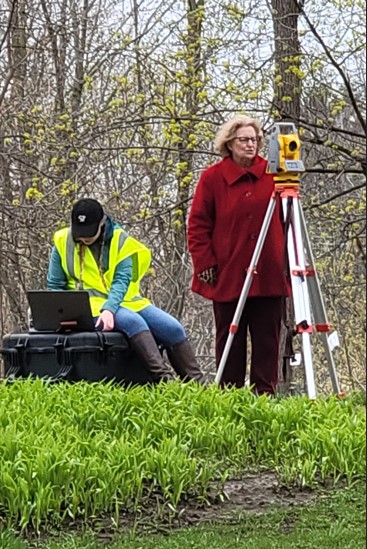

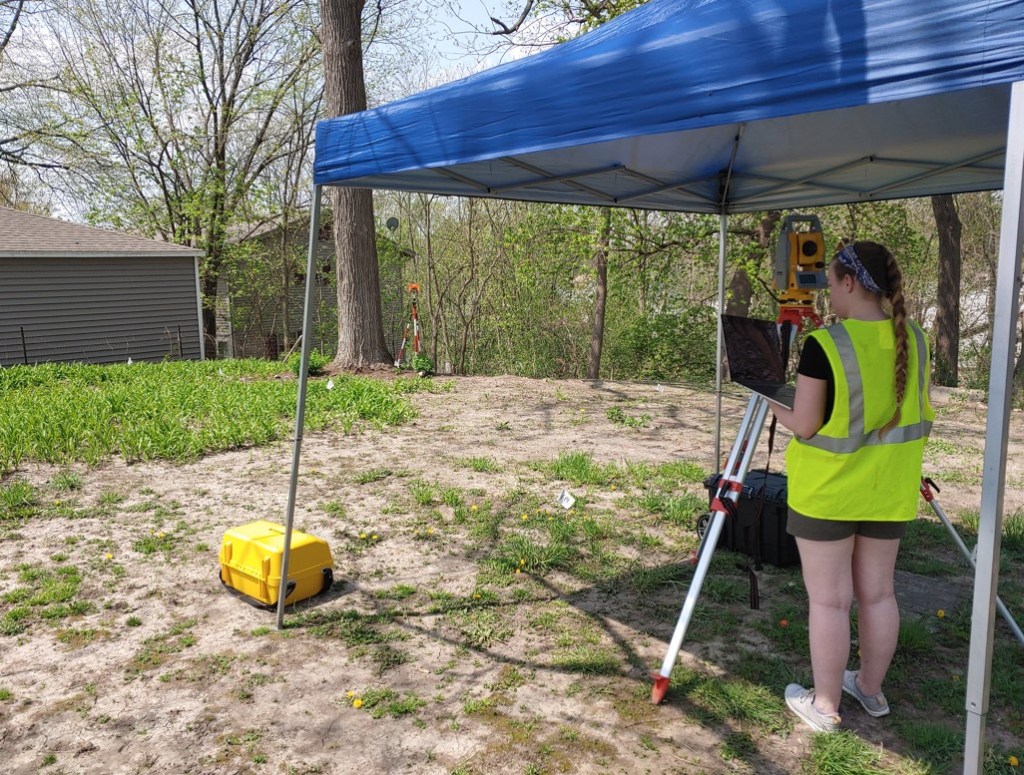

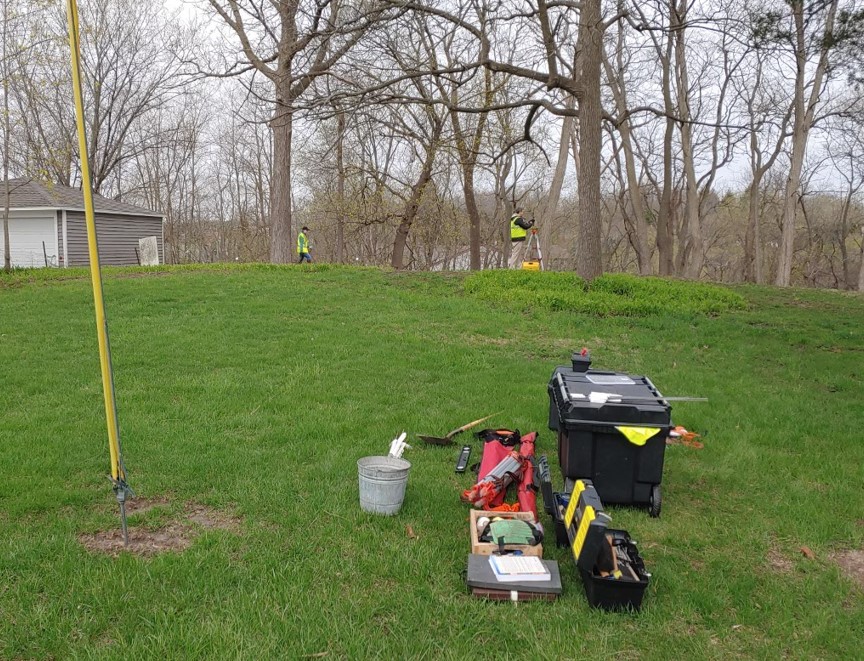
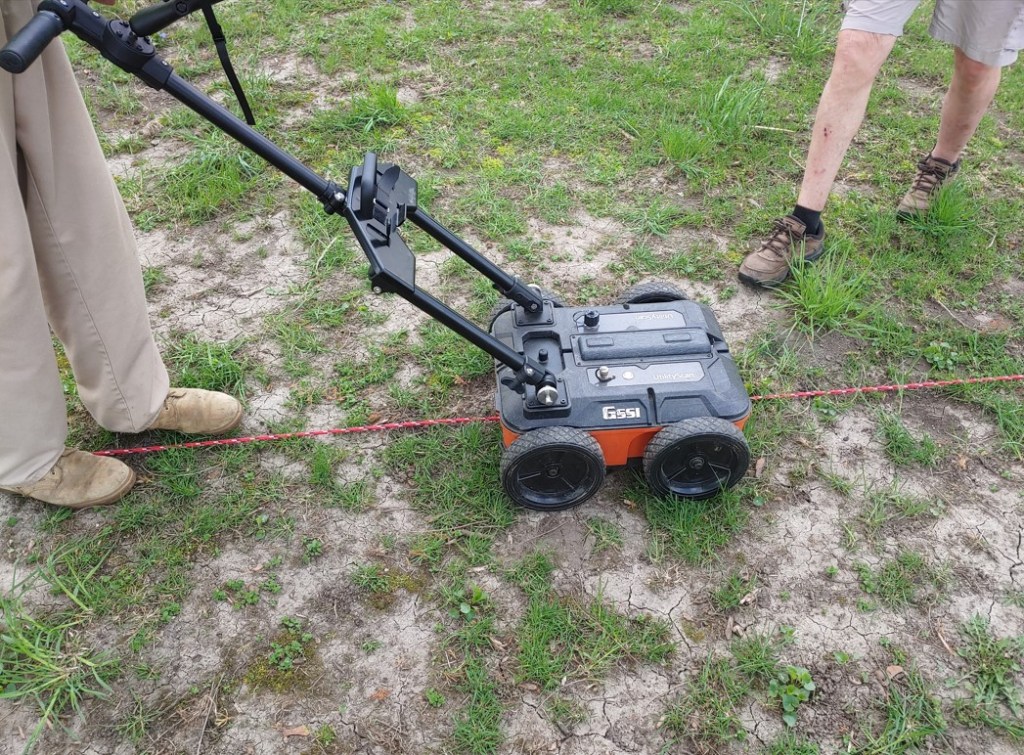

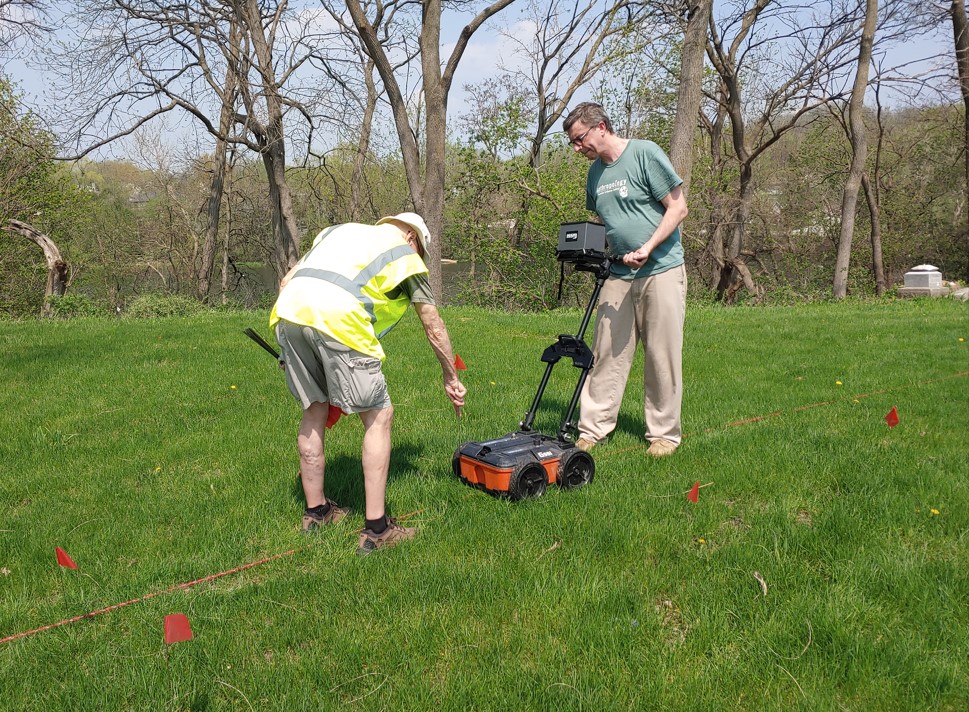

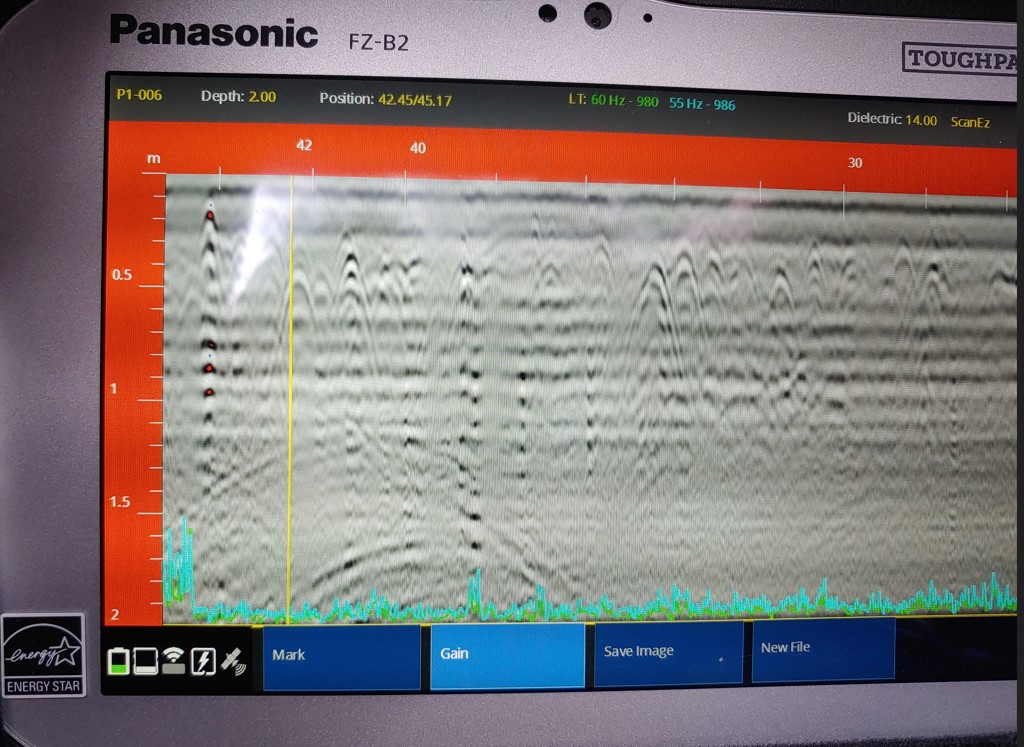

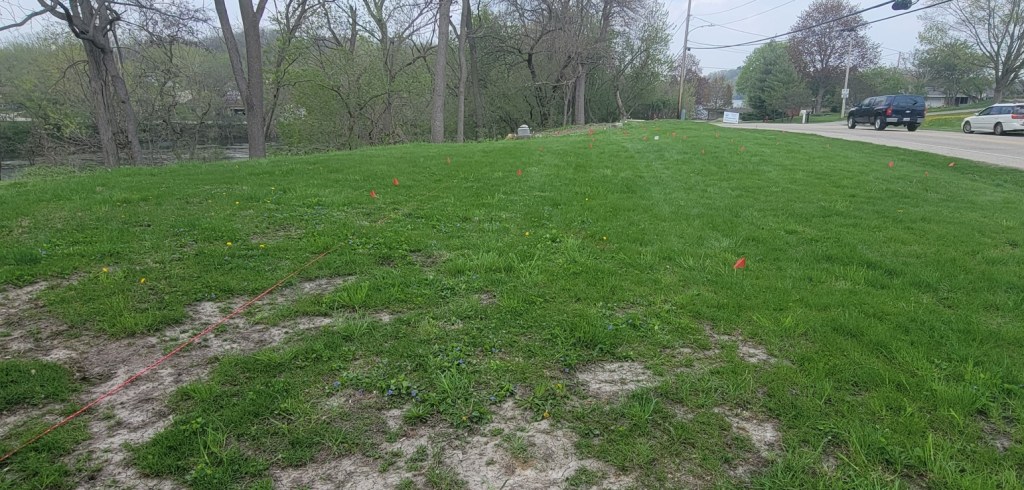
Results of the survey show that there were at least 76 burials on the site. Since some of the area was heavily treed, the complex root structure can obscure the scan and there may be a few more under the existing large walnut trees.
It was decided to mark the burials with cast concrete markers labeled as “UNKNOWN” until positive correlation could be made with fallen tombstones. Volunteers cast the stones and installed them in appropriately-identified rows. Flat stones were chosen to facilitate maintenance by the Village Parks and Facilities Department.
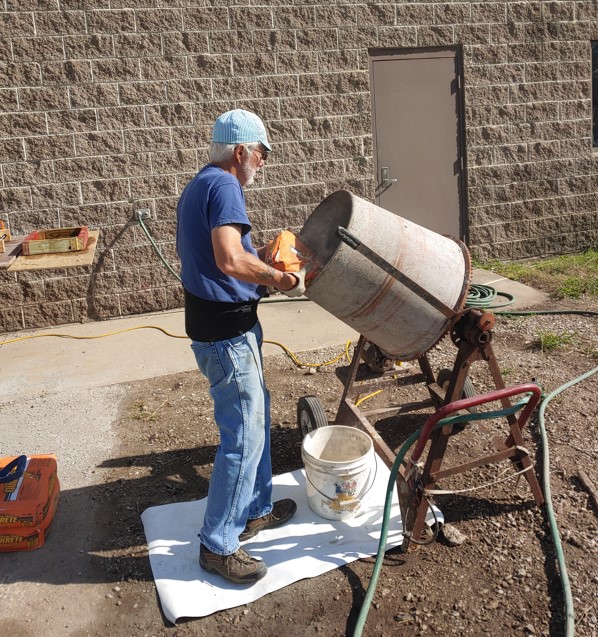
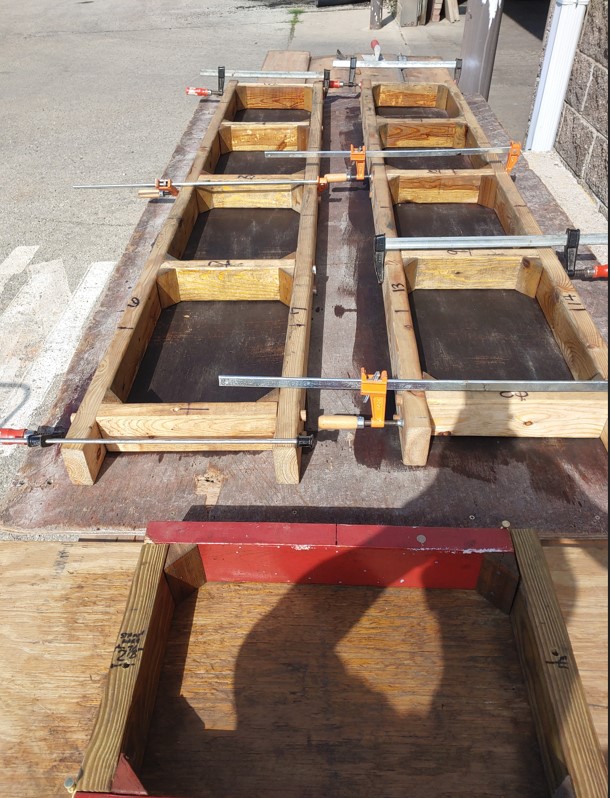

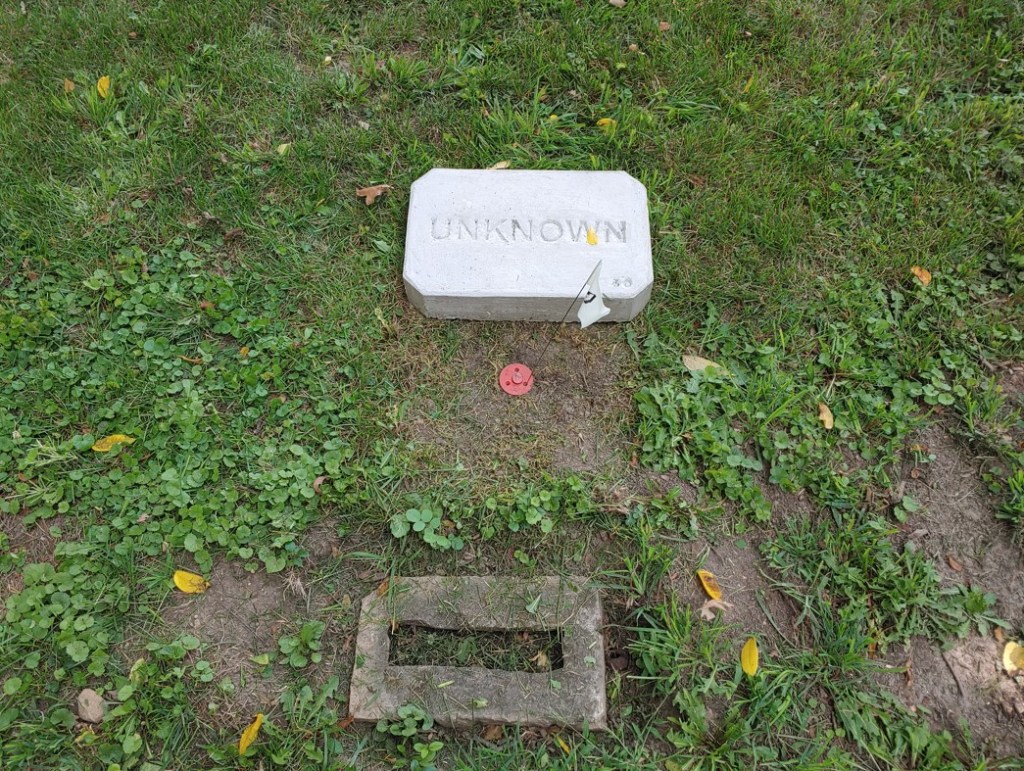


Existing bases are used where possible for the repaired identified stone and plot. The remaining fragments will be properly displayed in a respectful manner in accordance with WHS guidelines.

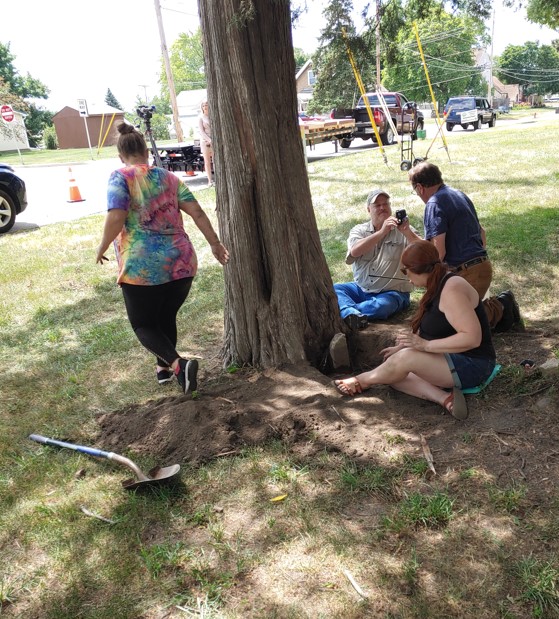




During the summer of 2024, a memorial gate was installed with an archeologist monitoring the excavation process. In the fall, a Wisconsin Historical Marker was installed to commemorate this site.
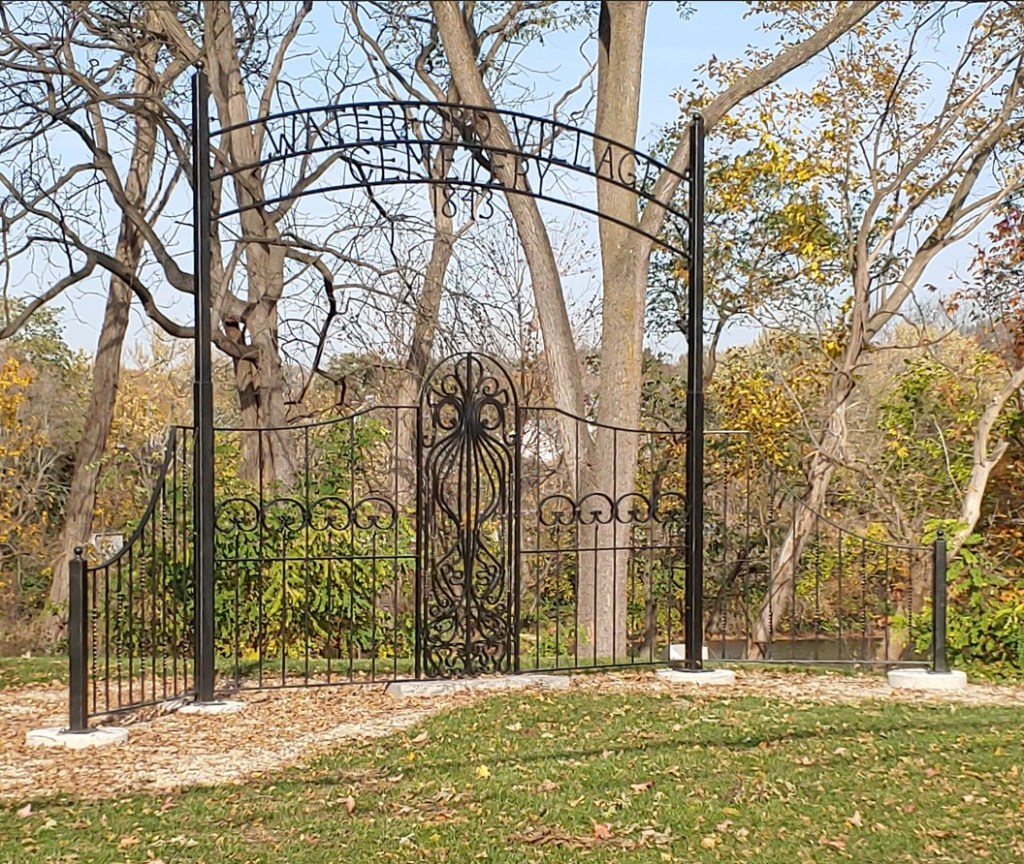
Memorial Gate Installed in Summer of 2024. Photo by R.E. Gariepy, Sr.
This memorial gate was designed and built by Mia Beauchamp and Ken Nelson of Iron Wolf Forge located in Sturdevant, Wisconsin. The center gate was designed by an artist-blacksmith at Northern Illinois University and donated by Judy Gambrel. Interpreting the artful center gate reminds us of an owl. This nocturnal bird, a symbol of many cultures and some native American tribes, is believed to accompany the dead on their journey to the afterlife.
Installation was done by Waterford Parks and Facilities Department and Ken Nelson.

Wisconsin Historical Society marker is #619. Photo by R.E. Gariepy, Sr.
“Waterford Village Cemetery – est. 1843
This cemetery was the original resting place of community members who were instrumental in founding Waterford. Village founders Levi Barnes and Samuel Chapman dedicated this site as the village’s first public cemetery in 1843, but burials date back to 1837, when Wisconsin was still a territory. Burials included several members of Wisconsin’s early state legislature, county supervisors, and local judiciary, such as Barnes, Chapman, Ira Rice, and Alfred Lockwood. War of 1812 veteran John F. Beedle is also buried here.
A law introduced by Rice in 1870 assigned maintenance of the cemetery to the Village. By 1880, as this site deteriorated, many families had decided to move bodies to other local cemeteries. The last known burial was that of Abigail Sawyer in 1908.
Please be mindful that by law, this is a protected burial site.
Erected in 2024
Waterford Heritage Committee
Wisconsin Historical Society”

A re-dedication ceremony was held in the old Methodist Church, due to the bad weather, on May 20, 2025. A bucket of cemetery soil was used by Pastor Bill Busch of Community Church in the ceremony and returned to the site.
A fitting end to this section is from the obituary of Mrs. Nancy Buttles, Old Settler – not buried here.

Segment of Mrs. Nancy Buttles Obituary as published in the Waterford Post, June 6, 1922.
Researchers: Robert E. Gariepy, Sr., Judy Gambrel, Elizabeth Noble.
NOTE: Should the reader have further documentation to enhance the content of this web page, please contact the researchers by email at: waterfordwiheritage@gmail.com. We are particularly interested in pictures or historic artifacts that may be shared. Credit will be given.
Sources:
- Commemorative Biological Record of Prominent and Representative Men in Racine County, J.H.Beers & Co., 1906.
- Wikipedia.com.
- Headstone Symbolism.
- History of Racine and Kenosha Counties pp.235-245.
- Ibid.
- Ibid.
- An English Settler in Pioneer Wisconsin – The Letters of Edwin Bottomley, 1842- 1850, Wisconsin Historical Society, Collections XXV, 1918.
- Ibid.
- Ibid.
- Ibid.
- U.S. Federal Census Mortality Schedules Index, 1850-1880.
- Findagrave.com .
- Waterford Post, articles listed above.
 The Legacy of Waterford, Wisconsin