
Early Development of Waterford Schools

Waterford Grade School Students – 1908.
Education was a valued tradition with some of Waterford’s more progressive pioneers.
School districts were established shortly after Wisconsin became a territory in 1836. Territorial legislation was passed requiring townships with more than 10 families to fund schools. It would be ignored by most for several years until the first free public school supported by property taxes was opened in Southport (now Kenosha) on June 16, 1845. This would be the first schoolhouse but not the first school. This model later became the foundation for the state’s public school system.
Back then, there were “schools” and “schoolhouses.” “Schoolhouses” were publicly-funded buildings and “schools” were private – or as some referred to them – a “select school.”
Within a few years after the first settlers arrived in Waterford in 1836, special schools were started to teach the young people the basic skills to function within society. The depth of the education was mostly limited to the Three “R’s” – Reading, ‘Riting’, and ‘Rithmetic’ while special, or “select” schooling was set up to provide more in-depth education and needed community skills such as bookkeeping, language arts, etc.
An article in the Racine Advocate dated October 24, 1843, written by Samuel Chapman, about the current state of Waterford says: “It has 150 inhabitants, has a good school…” It documents that education was in process during the early days of the settlement of the village.
As district identification numbers changed over the years with geographical combinations and inclusions of schools from outside of the area, the following narrative will be limited to those schools merged or lying within the Waterford township.
Training the Teachers
Early teachers were educated in language arts and mathematics without any special education of “how” to teach. To be qualified and secure a position as a teacher, candidates were allowed to write on a teacher’s examination after completing the eight grades. If their grades were up to the standard, they were permitted to teach. When formal education became the charge of the community, standards were set for hiring qualification. Those who wished to teach school, had to attend a six-week summer session at a Normal School after they finished high school.
Teachers’ pay was meager and was often supported by “Boarding Around” which meant that the teacher would stay with another family who would supply their food and lodging in exchange for tuition. Many early public-school teachers boarded near the schoolhouse. Some old records show who boarded where.
The following narrative starts with the private schools since they were the first to operate. Some students are from close neighboring areas but are not in the township boundaries which shows that school district boundaries do not correspond with township boundaries.
Private Schools in the Village
A few private schools were the first attempt at educating young people. In the village, all the private schools were located on the west side of the river except for St. Thomas. However, St. Peter’s school started out on the west side but moved to the east side when a schoolhouse was built.
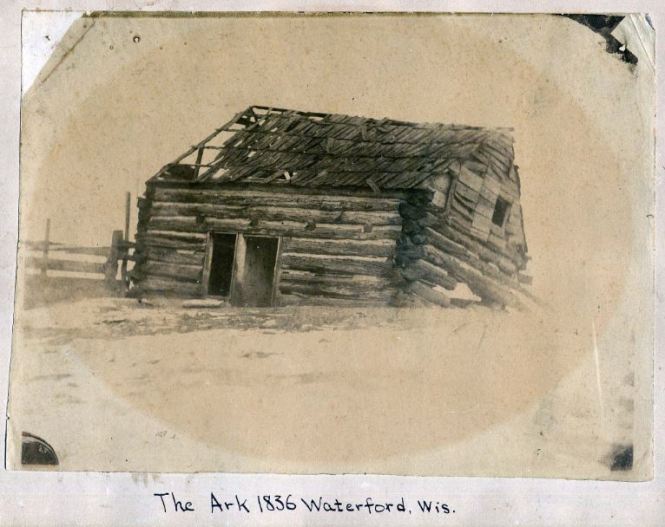
Original Chapman-Barnes Log Cabin.
Village founders, Chapman, and Levi Barnes, built a log cabin – located behind the current Enve Salon and Day Spa – for the two families, as they started the development of this hamlet. It was also the stopping place and “community center” for new settlers as they transitioned to their own homesteads. Family memories state that Mrs. Martha Short, daughter of Barnes and sister of Chapman, was the first teacher in the “Old Ark” sometime in the 1840s.
Mrs. Lydia Carr, in her memoirs, recalls going to school in the upper level of Miss Ruth Chapman’s home in the mid to late 1850s. It was referred to as a “select school” located at the southwest corner of South Jefferson and Washington streets.
Miss Louise Weage held classes in the second floor of her father’s building located on the southeast corner of West Main and River streets. The school could accommodate between 30 to 40 students. For three or four years, it was referred to as the “school de luxe” of the village. It was the first to have individual seats.
In the evenings, another school was held in the lower level of the Weage building for older boys with the goal to produce workers for the commercial activity in the area. Teaching was done by Mr. Berge, a German. Its curriculum consisted of business courses and the German language which was very helpful to serve a large group of German immigrants living in the area.
Another private school was held in the west wing of the Samuel Chapman home near the southwest corner of West Main and North Jefferson. Imogene and Ellen Chapman were the teachers. Its years of operation have not been documented.
Mrs. E.M. Groat recalls attending a private school taught by Mrs. Bent, a widow, in the mid 1850s which was located near the northeast corner of West Main and Water streets.
St. Thomas Aquinas School

1851 St. Thomas Church Also Used as the First Parochial School. Photo restoration by R. E. Gariepy, Sr.
According to parish historical records, parochial education began in the winter of 1851-52 under the leadership of the first pastor, Fr. Kundig. A Mr. Luig offered a room, its location is unknown, for the school and Mr. Lensing taught 12 students for $8 a month. In 1852, a 10-by-20-foot addition was made to the new church of which half was to be used for the school.


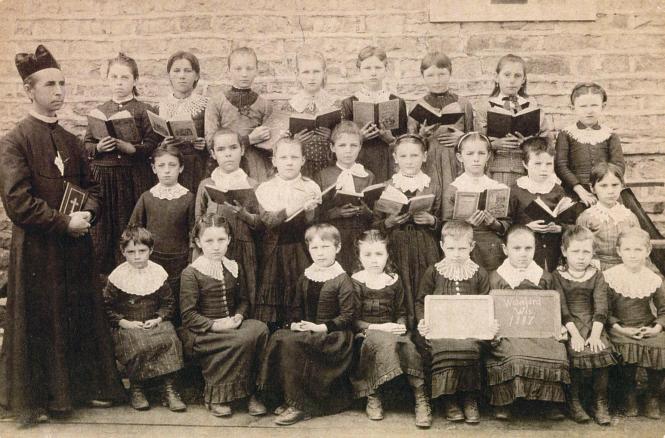
1903 photo of 1864 St. Thomas School and Students. St. Thomas Archives.
By the early 1860s, the village and the Catholic community had grown to a point that a larger schoolhouse was badly needed. In 1864, a two-story stone building measuring 46 x 30 feet was constructed with two spacious classrooms, a chapel and four rooms for the teaching nuns. Parishioners paid for the building by offering materials, labor, and donations. This schoolhouse was modified and enlarged through the following years to accept a growing student base until 1941 when the next building was constructed.
The “’41 school”, as it became known, was located directly behind the 1880 church, on the location of the original 1851 church/school. It had separate classrooms for all eight grades including a cafeteria. The 1864 building would continue to be used.
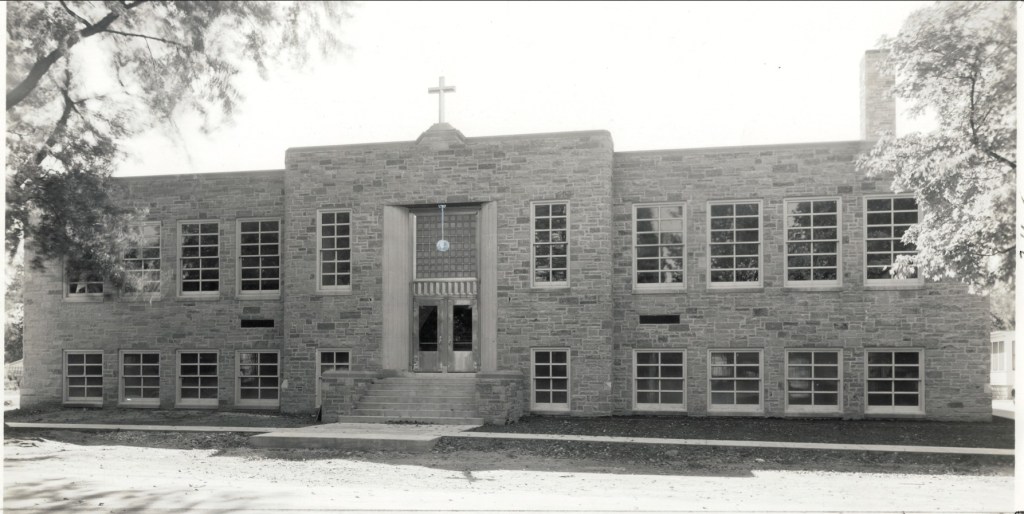
1941 St. Thomas School Addition. St. Thomas Archives.

1959 St. Thomas School Addition. St. Thomas Archives.
In 1959, another addition, located on the Second Street side of the 1941 school, was built to accommodate the ever-increasing student population. Enrollment peaked in 1964-65 with 452 students necessitating two classrooms per class in some years and overflow into the old 1864 building until 1966. According to parish records, it appears that the enrollment decreased significantly when non-payment of tuition was enforced.

1980 St. Thomas School Addition. St. Thomas Archives.
A gymnasium, also known as the Parish Activity Center, or Uhen Center, was dedicated November 16, 1980 and was the last of the school expansion.
In 2005, the old 1864 school was torn down to make way for the new church built in 2007. St. Thomas school closed permanently at the end of its 2019 school year in June, due to dwindling enrollment of under 50 students.
St. Peter’s School

St. Peter’s School Location on 1911 Sanborn Map.

St. Peter’s Grade School Class ca. unknown.
St. Peter’s German Congregation dates to 1856-57. The original church was not built until 1864 and was located on the southwest corner of North Third and Division streets. In the Fall of 1865, a house was rented on the west side of the Fox River for the Pastor, Rev. Engelbrecht. A school was started in the pastor’s residence for the fall and winter classes. During the warmer months, classes were held in the church until a permanent schoolhouse was built in 1872. It was a small structure added to the northeast corner of the church lot. A regular teacher was employed or the pastor substituted as the instructor.
The school operated for a number of years but an article in the 1923 Waterford Post publication, Stories of Waterford and its Busy Life – Waterford Schools, indicated that it had ceased operation “a number of years ago.” It is assumed that the small school building was torn down in 1928 when the old church was razed to build the new one on the same site except facing in the easterly direction.
Public Schools in Waterford Township
Waterford Village School District 1
Waterford was not far behind Southport in public school development.
The first meeting toward establishing a schoolhouse was held June 29, 1844, at the home of Samuel Chapman. A committee was instructed to select a date and draw up plans. Originally, the proposed schoolhouse was in District #9 in Rochester Township. After the formation of the Township of Waterford, the school districts were revised and this school would be in District #1.
By July 2, the plans were ready. The school building was to be wood frame, 22-by-29 feet, with nine 15-panel windows and one door. The building was to be covered with oak or basswood.

Top Half of Chapman Deed to Rochester School District #9 – September 22, 1845. Racine County Register of Deeds.
After more meetings, the town board voted to tax for the building and purchase a plot of land. Chapman sold the parcel to the district for $10 as recorded on the registered deed dated September 22, 1845. The records show that citizens who failed to pay “school taxes” would have the tax collector “collect by distress and sale of personal property.”
In the end, a brick schoolhouse was erected instead of a frame structure. It would become known as the “little red brick schoolhouse” amongst the villagers for many years to come. Disputes must have continued since the trustees were forced to vote an additional $180 to finish the job in June 1847.
According to old Chapman letters, Miss Imogene Chapman and her sister Ellen were the first teachers for which they were paid $4 a week., at the end of the term of 10 weeks. There were 40 pupils in attendance to start the first school term.
Other Uses of “Little Red Brick Schoolhouse”
. Town Hall
. Public Meeting Hall
. Church services, Sunday School, prayer meetings for various denominations
. Theater
. Lights were provided by neighbors who brought lanterns.
. Music provided by the Chapman melodeon brought from the family home
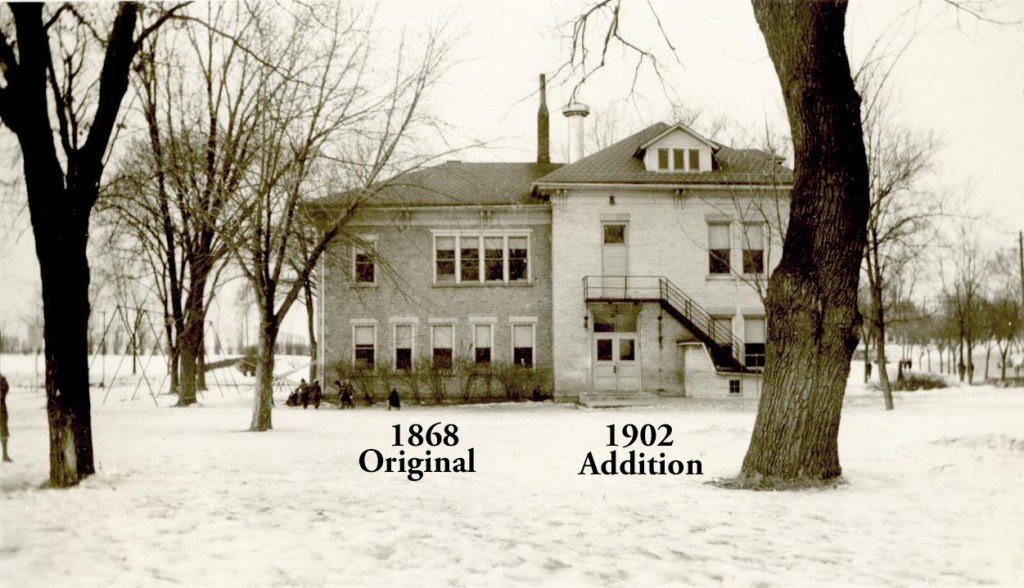
Two Story Brick Schoolhouse with the addition.
As the village grew, it became obvious that a new building was needed. In 1867, money and plans were appropriated to build a new schoolhouse. It was completed in 1868 on the site of the “little red brick school”, which was located on the southeast corner of West Main and Center Streets. The two-story building operated eight months of school – four months during winter and four months in the summer. Winter school was taught by a “male teacher who received $50 a month and his board.” The summer term was taught by a “female teacher at $30 a mo. and board”. Perhaps the difference in wages was due to more maintenance work being required of the teacher in the winter months
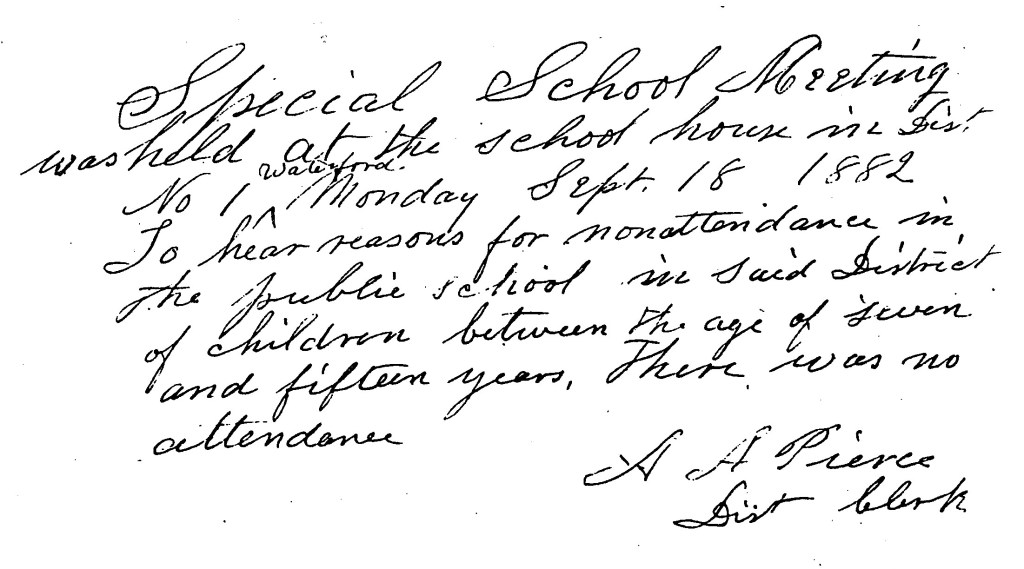
Special School Meeting Announcement – September 18,1882.
School attendance was not always a priority depending on the time of year as evidenced by a note left by the District Clerk – “Special School Meeting was held at the school house in Dist. No. 1, Waterford, Monday Sept. 18, 1882 to hear reasons for non-attendance in the public school in said District of children between the age of seven and fifteen years. There was no attendance.”
During the summer of 1902, a large brick addition was added to the front of the building facing Main Street.
In 1904 the district added a free high school department. The upper story would be dedicated to the high school. When school opened in the fall, enrollment was 102 with 42 assigned to the high school. Students from other districts attended to further their education beyond the primary grades.
On June 13, 1906, the first class graduated with a high school diploma and consisted of six students who had begun their work elsewhere.
The first class to graduate after completing the four-year course at the same school, consisted of six students, graduated June 17, 1909.
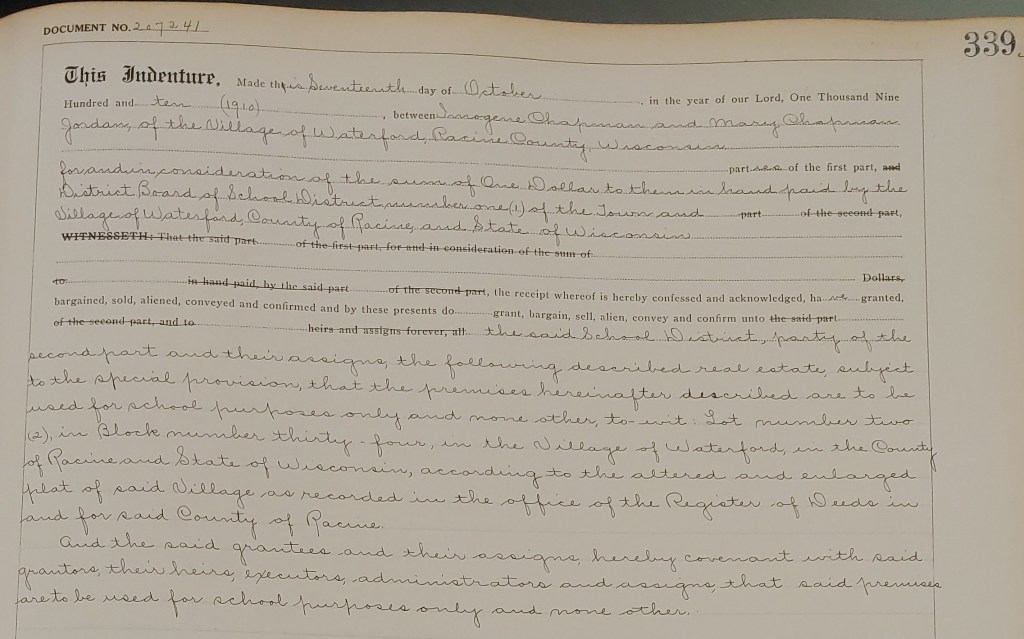
Imogene and Mary Chapman deed to District #1- Top Half. Racine County Register of Deeds.
As the area continued to grow its population, it was time to build a new high school building. In 1910, Mrs. Kehlor, granddaughter of Levi Barnes, offered $5,000 to build the new school with the requirement that it be called Levi Barnes Memorial High School. The district was to raise an equal amount. Granddaughter Imogene Chapman donated the land. The district accepted the offer but it was not until 1916 that the first session was held in the new building. While the initial building had the name of “Levi Barnes”, it was later dropped when the next addition was made and it became known as Waterford Union High School.

Original Levi Barnes High School c.1916.

Aerial View of Levi Barnes School and Waterford Grade School District 1.

1963 Referendum Listing Past and Proposed New Additions.
Webster School District #2

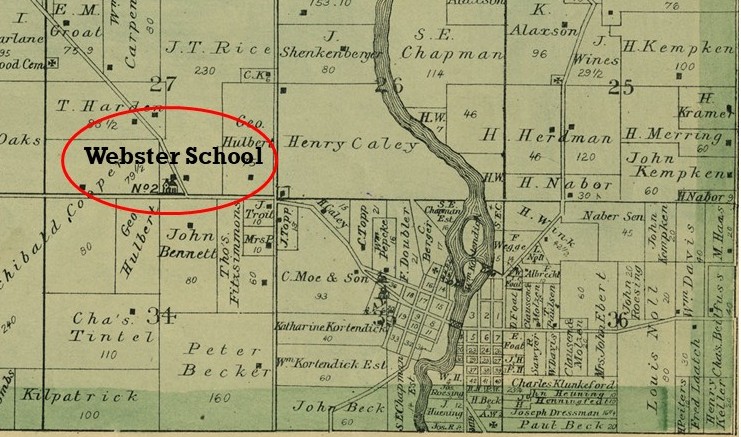
Old Webster School in Background. 1887 Map Showing Location.
About a mile west of the Village at the corner of State Highways 83 and 20 (High Drive) is the original location of Webster School. In 1872, money was raised to build the school which opened in February of 1873. Records indicate that Roscoe Hoyt was the first teacher and was paid $152 for the first term which included other odd jobs at the school – i.e.: cleaning, start the fires and keeping them burning.
Classes were held there until the spring of 1943. Starting in the fall of 1944 the students, were “tuitioned” into Waterford District #1 in the village. The building sat unused for 10 years until 1953, when sealed bids were taken for the sale of the building with the proceeds and balance of funds merged into district #1. The building no longer exists.
High Street School District #3

High Street School c.1915.

1887 Map Showing Location.
Located about 2-3/4 miles west of the village near the intersection of State Highway 20 (High Drive) and Maple Road is the former site of the High Street School – named after the road it was on. It is not known when the original school was built but it shows up on the 1858 township plat map which makes it one of the oldest in the area. The 1858 Map is of poor quality for reproduction so the locations are shown on the 1887 map.
The original building was torn down in 1909 and a new one built in 1910. The largest class it ever served was 12 students.
Mrs. Eva Powers was the first teacher in the new school for which she was paid a salary of $40 a month. Records show that there were six students in 1941 being taught by Mrs. Caroline Behrend. The school was finally closed in the spring of 1945 due to low enrollment. An auction was held in 1946 for the sale of the building which was subsequently moved to a new location on Hill Valley Road to be used as a residence.
Over the years of operation, it was somewhat of a community center hosting some of the following events:
. Church services
. Parties
. Basket socials
. Dances
. Funerals
Buttles School District #4
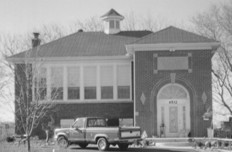

1922 Buttles School c. 1960. 1887 Map Showing Location.
No records exist about the original schoolhouse which was known as the Buttles School. It is shown on the 1858 map located on the B. Buttles property which is about 4 ½ miles northwest of the village on State Highway 83. Records indicate that an original school building was there prior to 1858 but was sold and removed to become D. Buttles’ blacksmith shop nearby. A second wooden clapboard building was built around 1858 and remodeled in 1916.
According to Mrs. Nancy Buttles obituary, the seats in the school were built close to the wall on three sides and the teacher’s desk occupied the 4th side. (Consider that this was a one-room schoolhouse with multiple classes.) “In front of the continuous seat was a desk of the same dimensions with an opening only at the center. When a class was called, those seated near the opening walked forward in a dignified manner, while the others stepped up on the seat and over the top of the desk ‘like a flock of sheep’ going to the benches in front of the teacher’s desk or stood and ‘toed’ the mark as they spelled or recited.”
School records show that the time of the year determined the wage level as evidenced by Emmett Berry being paid $30 a month for the winter term and Ella Ela being paid $23 a month for the spring term. By 1928, the rate had increased to $130 a month regardless of term. Attendance records show 22 students in 1870 and 33 in 1879.
In 1922, a brick schoolhouse was built on the same site replacing the old clapboard building. It remained in operation until the early 1960s when it was consolidated into the Waterford Graded School District and continued to be used as a special education school for the district for a short time thereafter. It was later sold and became a residence.
Ranke School District #5
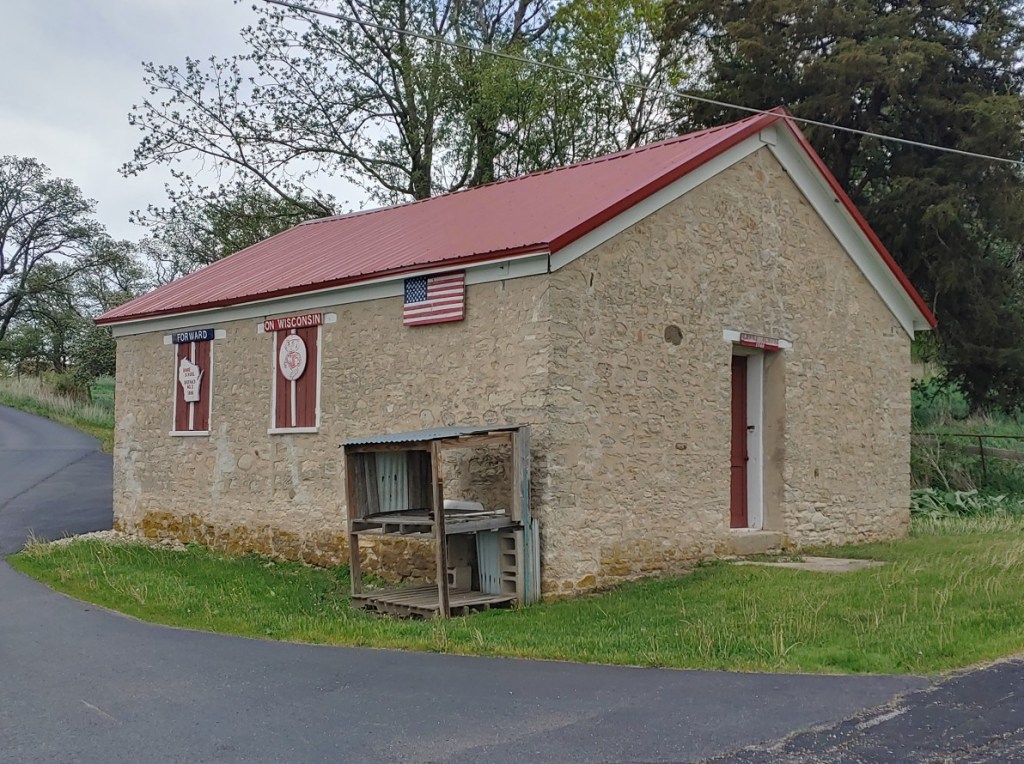
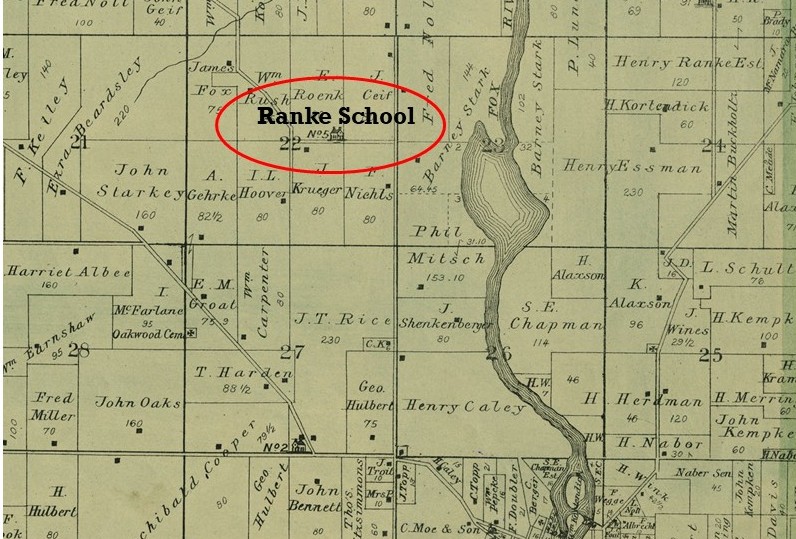
Ranke School in 2025. Photo by R.E. Gariepy, Sr. 1887 Map Showing Location.
There are no records citing when the first Ranke schoolhouse was built. However, it is shown on the 1858 township map. It was a tiny stone structure located in a very picturesque setting along the north side of Ranke Road about 2 ½ miles north of the village.

Ranke School Class c. 1880.
This class picture was originally submitted by Mr. Harold Ranke showing the teacher in the middle with girls on her right and bare-footed boys on her left, which was the segregation of the day.
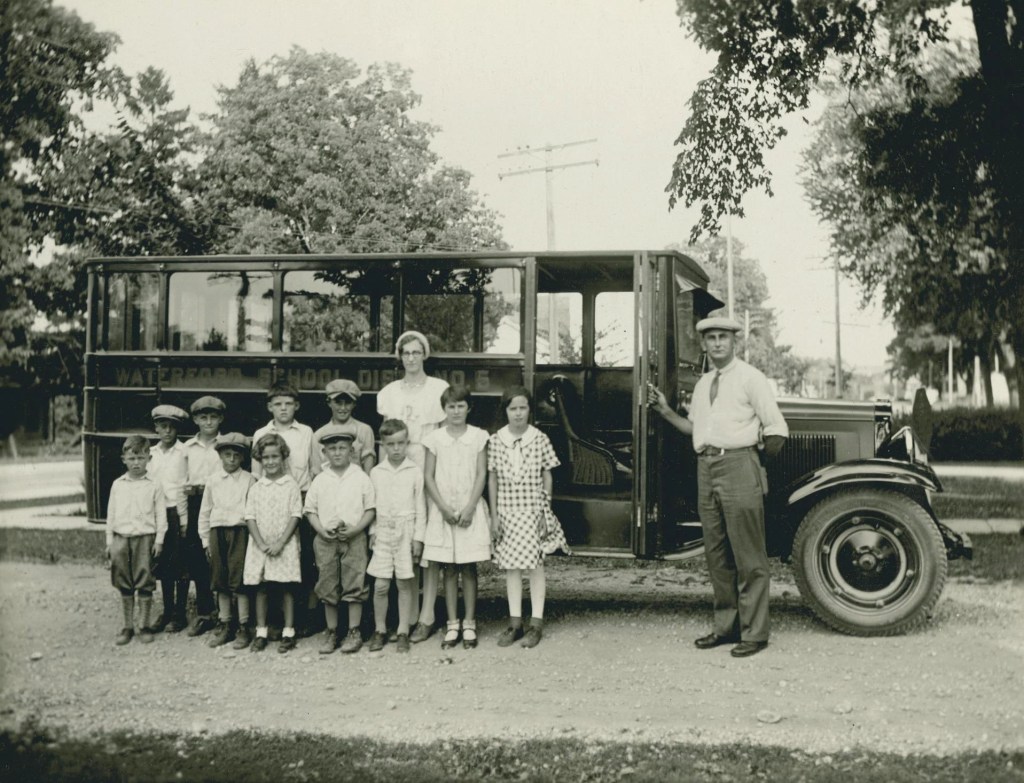
1930 Chevrolet School Bus with Ranke School Students.
Parents took turns for many years taking and picking up their children from school. In August 1931, the school board authorized the purchase of a 14 seat 1930 Chevrolet school bus for $1,180. This was to be the first rural school bus route in Racine County.
Operation of the Ranke School continued until 1951 when the board voted to consolidate with Waterford Graded School District #1.
Caldwell School District #6
While few records exist, the first school held in Caldwell Prairie, which is in the very northwestern part of the Township of Waterford, was called the Rochester School. At that time, the area was in the township of Rochester. Its exact location is unknown. In 1849, the second schoolhouse was erected. It was a “Gravel Stone School” measuring 26-by-30 feet and 10 inches. The walls were 10-inches thick with one-inch-thick oak floors. Sixteen desks, four-feet long, plus the teacher’s desk filled the space. Its cost, including the site, was $300. It was located across the street from the existing “old” school.
Records show that its first teacher was A.H. Holbrook who was paid $14.50 a month. Thirteen students were enrolled.
Old Caldwell School.
In 1869, the existing “old” school was built of Milwaukee Cream Style Brick and cost about $1,800. Over the years, improvements were made to bring it up to date such as windows added, kitchen, furnace, lights, and indoor toilets.
In 1970, the Caldwell district merged with the Washington district since they were also re-aligning. Caldwell’s school became a private day care school for a few years and is now a residence.
Pilgrim School District #7

1910 Pilgrim School – District #7.
According to a research paper in the Leach Collection, the first school built in District #7 was called the Ranke School in 1867, not to be confused with the Ranke School mentioned above. Located on a small hill on the west side of State Highway 164, about 2 ½ miles north of the village is “the old Red and Green school” as referred to by some of the old settlers. Perhaps it had to do with the painted colors of the school but no records exist. Records show that the teacher in 1884 was paid $24 a month with an enrollment of 19.
In 1910, the old school was torn down and the current building was erected on the original site for $2000. Its name was changed to Pilgrim School.
Records show that the initial enrollment was 43 students in 1867. It never reached that level again with the low point of nine students in 1915. From 1915 to 1919, students were “tuitioned” into Waterford District #1 in the Village. Classes resumed at Pilgrim School in 1920 and continued until 1954 when the district voted to merge with District 1.
The Pilgrim School was sold in 1957 for $1,900 and is used as a residence.
Washington District #16

1887 Location of Old Washington School.
Located in the far northeast corner of the Town of Waterford on State Highway 164 is the location of the first school in this district which was built in 1849 at a cost of $200, including the site. District #16 appears to be part of the Waukesha County school districts at that time. The building was a mere 16-by-22 feet and 11 feet tall, constructed of logs, pine floors, oak roof boards, and pine shingles. District members could either supply materials or pay tax money at 4 cents a square foot, or labor at a rate of $5 a man, for construction. School opened in December 1850 with 3 ½ month terms scheduled around planting and harvesting. A six-day weekly scheduled was used.
Subjects taught were: reading, writing, arithmetic, grammar, spelling, geography, physiology, agriculture, and citizenship. Mrs. L. Robertson was reported as the first teacher with a full student enrollment of 29 students ranging in age from 4 to 34. The oldest record of a teacher’s salary was $20 a month in 1868.
The first school was in use until 1903 when it was replaced by a second school. Construction started in 1902 and was halted half way through by edict of a special board meeting and a vote of 37 to 36 to halt construction. By June, the electors reconsidered, and construction continued until completion and opened in 1904. Outhouses were used until 1952.
Washington-Caldwell School District
In 1970, the district was re-aligned with portions going to the Waukesha County Mukwonago District. The Caldwell district merged with the Washington district, now called the Washington-Caldwell School District, and all students attended Washington School, on the southeast corner of highway 164 and Townline Road – both wholly in the town of Waterford.
There have been numerous consolidations, building changes, and new elementary schools built as the village grew, namely:
. Evergreen Elementary School – 1991.
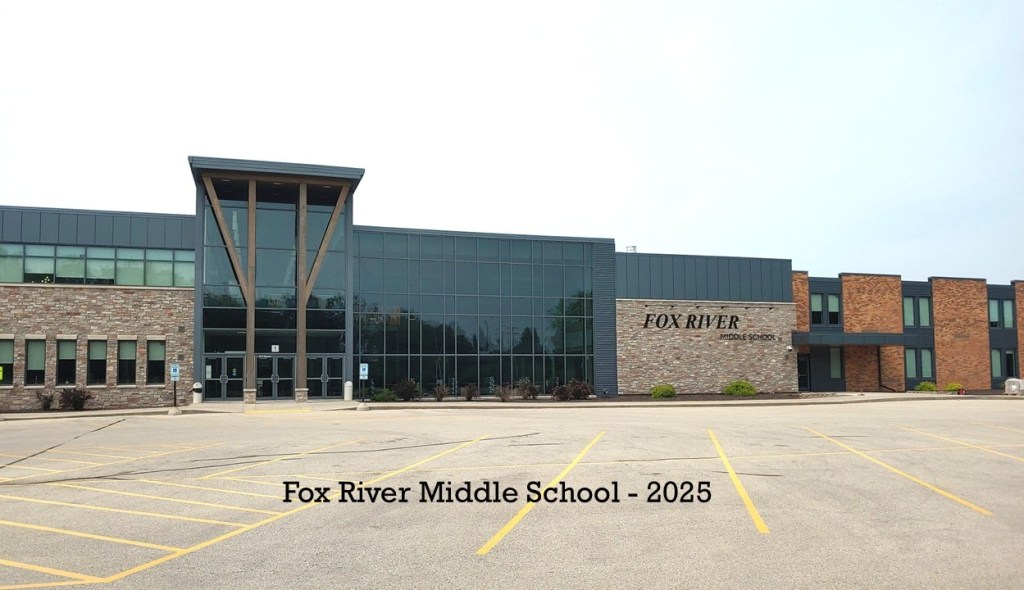
. Fox River Middle School – 1967.
. Maple View Elementary School.
. Trailside Elementary School.
. Washington-Caldwell School
. Woodfield Elementary School.



Other Affiliated Schools:

Rochester Grade School c. 1906.
1968 saw the consolidation of the Rochester School with Waterford Graded School. Students transferred to District #1 schools, except for kindergarten which remained in Rochester. The remainder of the students transferred to Waterford with the opening of the Evergreen School in 1991.
Today, the old Rochester School building is the home of the Rochester Area Historical Society and the Rochester Public Library.
Rochester District #3 – Pleasant View School
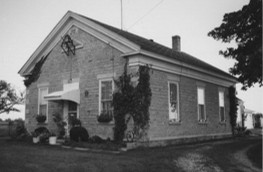
1866 Pleasant View School.
The first school was taught in a little red brick school house by Mr. C.W. McFarland with an enrollment of 50 students. Apparently, that school proved to be too small and a second school, also known as Hewitt School, was built in 1866 at the corner of County Road D and Heritage Road.
Enrollment gradually diminished to 15 students in 1928 which led to the consolidation with Waterford District #1 in the early 1960s.
Like many of the other little schoolhouses, it was sold and became a family residence.
Rochester Academy

Rochester Academy in Late 1800s.
Initially built as a stone building for use as a hotel in the 1840s, it became a “Select” school in 1866 sponsored by the local Baptist Conferences until 1890. Typical tuition was $14.25 and board was $13. The Congregational Conference bought the building in 1894 and continued operation until 1910.
In 1930, it was torn down and the concrete front steps remained in place at the southwest corner of Main and State Streets until 2023 when the highway was reconstructed. Since the school population was from many areas, some were sent into the Waterford District #1.
Rochester Agricultural School

1912 Rochester Ag School.
In the early 1900s, there were eight agriculturally-based schools in Wisconsin. The basis of this educational experience was to orient the students to the skills needed for the successful operation of agricultural pursuits. Farm families felt that the public school system did not address their needs. A 1911 study in Wisconsin showed that rural youth would not attend school beyond eighth grade if it were not for the Ag School alternative. Its organization was much like a modern-day vocational training offering. It opened in November 1912 with a wide variety of classes offered for both boys and girls to address specific skills needed for farming – Farm Mechanics, Soils/Fertilizers, Stock Judging, History, Farm Management, Feeds/Feeding, Cookery, Veterinary Science, Bacteriology, Household Sanitation, Architecture, Dietetics, Sewing, Dressmaking, and Manual Arts. It was a very successful program as attested to by the addition of a two-story dormitory for those attending from outside the Rochester area – girls on the first floor and boys on the second.
Classes at the Ag School continued until its last graduation in May 1959. In July 1959, Racine County sold the facility to the Waterford High School Board. It remained closed until plans for a Junior High could be formalized. In February 1960, Waterford Grade School District decided to lease the facilities from the High School District. Junior High classes began for 7th and 8th grade students until September 1963 when it was expanded to include the 6th grade students.
Waterford Junior High moved out of these facilities and into the new Fox River Middle School when it was completed in 1969.
After sitting idle for eight years, the empty Racine County Ag School buildings were demolished in 1977 to make way for a new residential subdivision.
Over the years, other outlying schools experienced consolidations with some of the students being integrated into the Waterford K-12 district at the high school level including Drought School and North Cape School.
Researchers: Robert Gariepy, Sr., Liz Gamble, Mike Schneider
NOTE: Should the reader have further documentation to enhance the content of this web page, please contact the researchers by email at: waterfordwiheritage@gmail.com. We are particularly interested in pictures or historic artifacts that may be shared. Credit will be given.
Sources:
A history of the Waterford graded schools -District #1. 1968 – Robbins, Douglas, 1968.
https://digital.library.wisc.edu/1711.dl/M4LKD3OQCTQVB8J
Stories of Waterford and its Busy Life – Waterford Schools, Waterford Post, 1923.
Development of a Public Education System in Wisconsin.
https://www.wisconsinhistory.org/Records/Article/CS2522
The History of St. Peter’s Lutheran Church, by Lydia Rossmiller, St. Peter’s Private Archives.
Waterford Graded School History, Leslie A. Ludtke, Rochester Area Historical Society Collection.
Eugene Walter Leech Collection, Wisconsin Historical Society Digital Collections:
https://content.wisconsinhistory.org/digital/collection/p15932coll13/search
The History of Education in the Waterford Area Through Early 1990s, Liz Gambel September 13, 2016.
History of Waterford, Alice Barnes Tindal, 1954.
Mrs. Carr Writes of Long Ago, Waterford Post, January 18, 1925.
 The Legacy of Waterford, Wisconsin